
I’ve been building custom industrial furniture since 2009. In that time I’ve watched our designs get copied more times than I can count — not just the aesthetic, but the actual pieces. Photographs lifted. Dimensions stolen. Then manufactured overseas, imported, and sold to buyers who have no idea what they’re actually getting. This is a field guide to telling the difference before you commit to something you’ll regret.
I came across a YouTube video recently showing one of these copies in detail — a knockoff of our IndustriaLux adjustable height crank table, manufactured in India, imported to the US, and sold at a fraction of what we charge. I took screenshots. I want to walk through what’s in them, because what they reveal is exactly what buyers can’t see from a product page. I’ve also written before about why most of what’s called industrial furniture is industrial in name only — this post gets into the specifics of how to spot the difference.
It Looks Like It Should Work
That’s the thing. From a distance — and certainly in a product photograph — it doesn’t look wrong. It has cast metal parts. It has a crank table base mechanism. It has a crank wheel. The silhouette reads as industrial. Someone browsing online who hasn’t handled the real thing wouldn’t know.

The finish is the first tell. One color, flat black, applied by rattle can. No depth, no variation, no hand-applied character. Our pieces have finish work that shows — not because we’re hiding anything underneath, but because the process is part of what you’re paying for.
The second tell is weight. This piece weighs somewhere between a quarter and half of what our IndustriaLux weighs. You feel it the moment you try to move it. That weight difference is a direct readout of material specification — how thick the steel is, whether the castings are solid, whether the structural members are sized to actually carry load.
Some sellers marketing these imports advertise “14 gauge steel” as though that’s a meaningful structural spec. It isn’t — not for an industrial adjustable table carrying real load. 14 gauge steel weighs 3.125 lb/ft². We build with ¼” hot-rolled plate, which weighs 10.21 lb/ft². That’s 3.27 times heavier per square foot — not because we’re over-engineering, but because that’s the spec required to build something that performs under sustained daily use for years. When a seller calls 14 gauge “heavy gauge,” they’re marketing to buyers who don’t know what the number means. Now you do.
The Crank Table Base Mechanism: Where It Actually Fails
The crank mechanism is where the spec cuts become dangerous. On this knockoff, the cast iron crank table base uses rough-cast gears — you can see the surface porosity, the unfinished tooth profiles, the slop in the mesh.

The screws are equally telling — shallow thread pattern, unevenly spaced, not a standard machine thread spec. An approximation of hardware. The crank wheel still has casting flash on the spokes, the raw overflow from the mold that a proper finishing pass would have removed.

This isn’t an isolated manufacturer. I’ve seen the same parts — the same rough gear mesh, the same shallow screws, the same unfinished cast iron crank table base components — on copies of our Hure crank table sold by one of the top-ranked sellers in this category. Different product name, same factory, same problems.

None of this is visible from a product page. All of it matters the moment you start using the piece.
The Other Thing You Can’t See: The Subframe
The mechanism gets the attention because it’s the part that fails dramatically. But there’s a structural problem with these knockoffs that’s just as telling and even less visible: how the top is supported.
Both of these imported tables use simple crossbars to connect the base to the top. That’s it. Two bars, spanning the width. No support at the center of the top, no coverage toward the ends. On a long solid hardwood slab — which can weigh well over 100 pounds and spans several feet — that’s not adequate. The center will sag under load over time. The ends are unsupported. And solid wood expands and contracts seasonally; if the anchoring doesn’t account for that movement, the top cracks.
We build comprehensive subframes from the same structural steel as the base. The subframe covers the center of the top — where the load is — and extends out toward the ends. It’s engineered to support the full span, not just the points closest to the legs. We also design for wood movement: solid hardwood needs to breathe, and our anchor systems allow for that expansion and contraction rather than fighting it. Depending on the table, we typically have 15 to 25 anchor points holding the top to the base — distributed across the full surface, not just at the corners.
A crossbar setup with four anchor points and no center support is fine for a lightweight veneered top. It is not adequate for a solid hardwood slab on a table built to last decades. This is another spec decision that’s completely invisible in a product photo and only reveals itself over years of use — or when you look underneath.
Heirloom vs. Disposable: The Visual Evidence

The Google Story
A client bought one of these tables. The client was Google.
After a few months of regular use — raising and lowering the height as intended — the gears stripped out. And this is where it stopped being a product quality problem and became a safety problem.
The table had a solid hardwood top. When the mechanism failed and they cranked it up, the top would drop — unsupported, uncontrolled, somewhere in the range of 100 to 200 pounds coming down without warning. That’s not a warranty issue. That’s a liability issue. Anyone near that table when it dropped was at risk.
They reached out and asked if we could fix it. We said no — the parts aren’t interchangeable, the spec is too far off, and there’s nothing in that cast iron crank table base worth saving. You can’t retrofit quality into a component that was never built to spec.
They commissioned a Bronx table from us instead.

That table has been in service at their headquarters for six years. That’s the real cost comparison — not the sticker price on day one, but the cost of a piece that failed and became dangerous, plus the disruption of replacing it, plus starting over with something built correctly. The cheaper option wasn’t cheaper.
What the Real Thing Looks Like
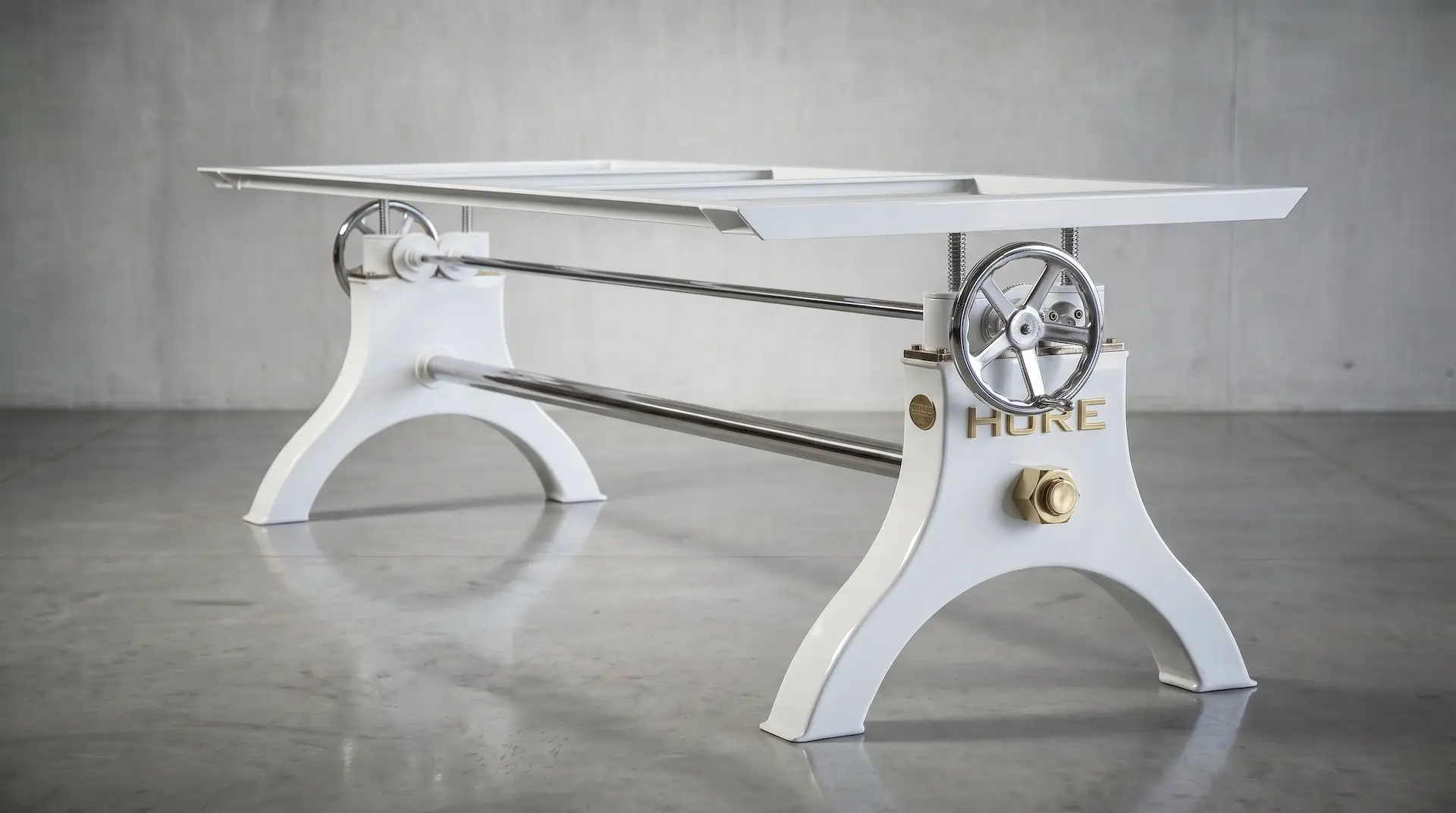
For contrast, here’s the IndustriaLux mechanism as we build it.

The gears are hardened steel — not rough cast. The teeth are machined to mesh cleanly under repeated load. And the screw mechanisms are sourced from a US manufacturer that has been in business since the 1800s — the same company supplies precision lifting and positioning equipment for industrial machinery like CNC machines, equipment designed to run 24 hours a day, seven days a week, under sustained industrial load. For a furniture application, that’s significant overkill. Which is exactly the point. A mechanism engineered for continuous industrial use doesn’t notice the demands of raising and lowering a table top. It just works — flawlessly, for as long as you own the piece — and frankly, it looks the part too.
The finish has depth because it was applied by hand in multiple stages, not sprayed flat in a single pass. The difference is visible in this photograph. The problem is that most buyers are comparing product listings, not mechanisms. By the time the gears strip — or worse, by the time a heavy top drops — the return window is long closed.
Designed to Be Discarded
Here’s what doesn’t get said enough: these imports aren’t designed to last. That’s not a manufacturing flaw — it’s the business model. The price point only works if the material spec is stripped down. Stripped-down spec means a lifespan measured in years, not decades. When the mechanism fails, the piece gets thrown away — the parts aren’t standard, they can’t be sourced domestically, and the manufacturer isn’t reachable.
The environmental math is uncomfortable. A piece replaced three times in fifteen years produces three times the waste, three times the shipping carbon, three times the manufacturing footprint of a single piece built to last the same period. We source solid, sustainably harvested hardwood and ¼” hot-rolled structural steel because we’re building things meant to outlast the people who commission them. The clients who bought from us fifteen years ago still have their original tables.
The Questions to Ask Before You Buy
A legitimate custom builder will answer all of these without hesitation. If the answers aren’t readily available, that’s your answer.
What gauge is the steel, and what does that translate to in weight per square foot? 14 gauge sounds substantial until you know it’s 3.125 lb/ft². Ask for the actual spec and compare it to ¼” hot-rolled plate at 10.21 lb/ft².
Are the gears hardened? Raw cast iron and hardened steel are not interchangeable. One machines cleanly under repeated load; one wears, develops slop, and strips.
Where are the screw mechanisms sourced? This is the component that will fail first if it’s underspec’d. Ask whether it’s a standard industrial lifting spec or something manufactured cheaply for furniture use only.
What does the finished piece weigh? Weight is the most honest proxy for material spec available to a buyer who can’t inspect in person. If you can lift it alone, it wasn’t built to structural spec.
Where is it built, and by whom? Not a nationalist argument — a supply chain transparency question. Knowing the origin tells you what quality controls applied and whether the manufacturer is reachable if something goes wrong.
Where to Buy a Crank Table That Will Last
Our industrial crank tables are built from ¼” hot-rolled structural steel and solid hardwood, to your exact dimensions, in our Phoenix workshop. Every crank table base mechanism is sourced to an industrial standard — not a furniture approximation of one. The same commitment to material spec carries across our conference tables and executive desks — pieces built for the rooms where they’ll be used every day for years.
If you’re furnishing a dining room, our industrial dining tables follow the same standard, and our dining table size guide will help you work out what the room actually calls for before you commission anything.
Come to us with the problem. We’ll build the solution — once, correctly, from materials we can account for.