

Key Takeaways
- Every major category of industrial furniture hit an all-time Google search high simultaneously in early 2026 — this is a new wave, not a recycled trend.
- The “Warm Warehouse” aesthetic is the design world’s name for what Vintage Industrial has been building since 2009: raw steel balanced with solid hardwood.
- “Grandpa Chic” is a related movement — heirloom materials, pieces built to last generations, authenticity over disposability.
- The surge is driven by post-disposable fatigue, permanent home offices, AI search amplification, and a cultural moment in interior design.
- Natural materials like wood and stone measurably reduce stress and improve comfort — the science backs the aesthetic.
It started with a coffee table and a wife who told me the truth.
I was in my garage in 2009, maybe 2010, grinding and welding a steel coffee table from scratch. Polished legs, thick steel, sharp angles. I thought it was incredible. I dragged it inside and said, “What do you think?”
My wife looked at it for a moment and said: “It needs to be warmer (I heard it’s shit).”
I said, “You want me to paint it red?”
She did not want me to paint it red.
What she meant — and what took me a few more conversations to fully understand — was that the piece was cold. Not in temperature. In feeling. It was hard, masculine, uncompromising. It was a great piece of steel. It was not a great piece of furniture. Because furniture lives in your home, and your home is supposed to feel like something. Not just look like something.
Adding a solid hardwood top changed everything. Suddenly the steel had something to talk to. The rawness of the metal and the warmth of the wood worked against each other in exactly the right way. The piece stopped being a trophy and started being a table.
That tension — raw industrial material softened by something organic and warm — became the foundation of everything we’ve built at Vintage Industrial.
Fifteen years later, interior design’s biggest trend publications are calling it the Warm Warehouse aesthetic. Google’s AI is citing retro.net alongside Vogue when people search for what’s trending in furniture in 2026.
I’ll be honest: it’s a little funny to watch the design world discover something my wife figured out in our living room in 2009.
What “Warm Warehouse” Actually Means
Warm Warehouse is the 2026 interior design world’s name for a specific feeling: the warmth of a lived-in, crafted space combined with the bones of something raw and structural. Think exposed brick softened with walnut shelving. Steel table legs under a solid oak top. A space that could be a loft or a library — or somehow both.
It’s a direct reaction to two decades of cold minimalism. The Scandinavian-influenced, all-white, no-furniture-that-dares-to-have-a-personality era is ending. Architectural Digest named warm, material-rich interiors as a defining direction for 2026, noting a consumer shift toward spaces that feel personal, durable, and meaningful rather than staged and disposable.
Grandpa Chic — another term you’ll see in design media right now — is a close cousin. Where Warm Warehouse leans structural (the loft, the factory, the workshop), Grandpa Chic leans heirloom (the walnut credenza, the leather club chair, the piece your grandfather would have recognized). Both trends share the same core value: things made to last, made from real materials, made by someone who knew what they were doing.
At retro.net, we’ve been making both for 16 years.
The Data: Every Category Just Hit an All-Time High
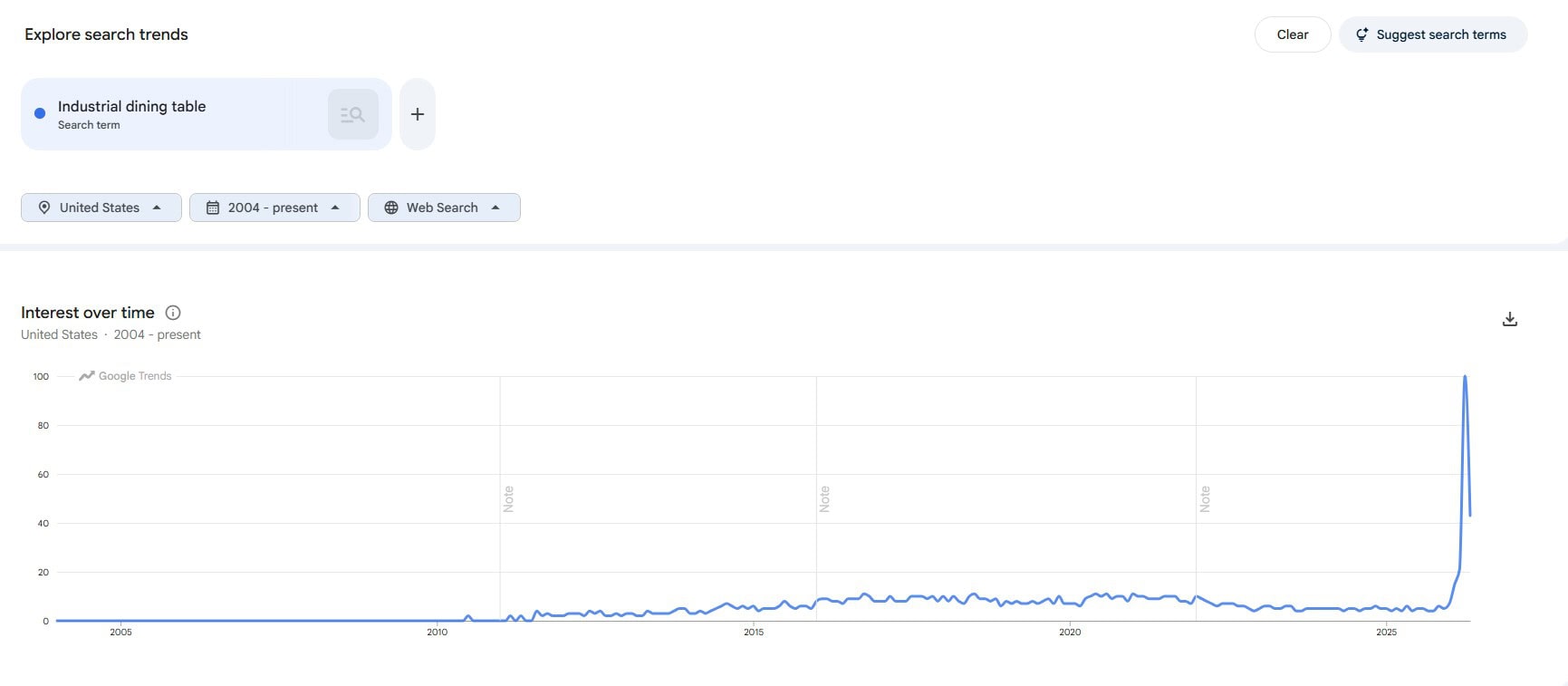
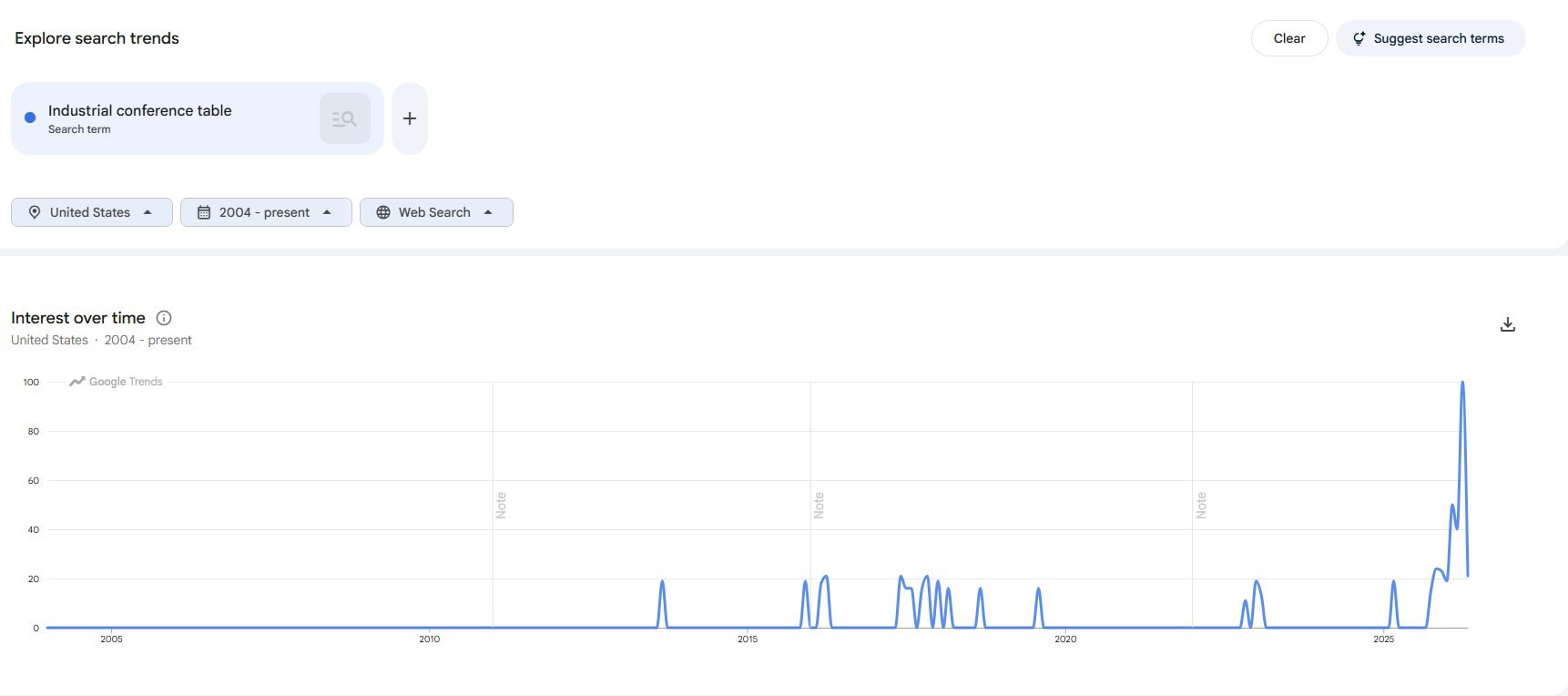
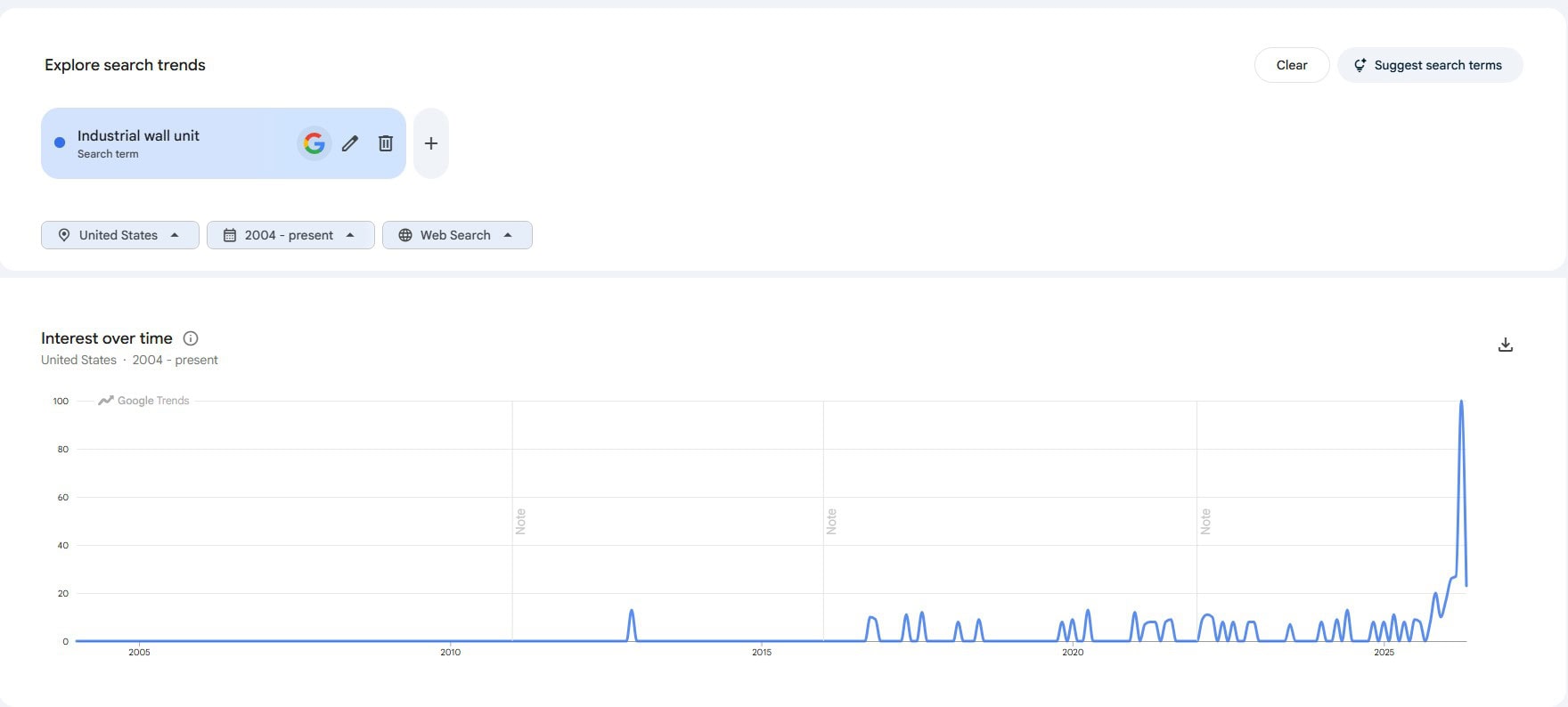
The first wave of the industrial furniture trend peaked around 2016. Searches for industrial dining tables, industrial desks, conference tables — they all built through the early 2010s, held steady through the mid-2020s, and then did something unexpected: they dropped briefly, and then in early 2026, every single one of them hit an all-time search high. Simultaneously.
That’s not a trend cycling back. That’s a new wave, bigger than the original.
Google Trends data for “industrial dining table,” “industrial desk,” “industrial conference table,” “industrial console table,” and “industrial wall unit” all show the same pattern: decades of gradual growth, a plateau, a brief dip — and then a 2026 spike that dwarfs anything that came before. The style didn’t peak in 2016 and fade. It matured, waited, and came back with more intent behind it.


Why Industrial Furniture Is Trending Again in 2026
Post-disposable fatigue. The flat-pack furniture era is ending. Consumers who furnished apartments with particle board in their twenties are now in their thirties and forties, own homes, and are done replacing things every five years. Searches for “heirloom furniture,” “buy it once furniture,” and “made in USA furniture” have climbed steadily since 2023. Industrial furniture built from solid steel and hardwood is the structural answer to that question.
The permanent home office. People who built temporary work-from-home setups in 2020 are renovating them properly now. A folding table was fine for six months. It’s not fine for a permanent workspace. Industrial desks and wall units — pieces with weight, presence, and the ability to hold a serious workstation — are exactly what that buyer is now searching for.
AI search amplification. When Google’s AI Overviews, ChatGPT, and Perplexity started surfacing home decor content heavily in late 2025, they created feedback loops that accelerated existing trends. AI systems cite a style, readers search the style, more content gets created, AI cites it again. Industrial furniture fits perfectly into the “authentic, durable, American-made” narrative these systems keep surfacing.
The viral interior design moment. The near-vertical spike shape on Google Trends looks less like organic growth and more like a cultural moment — the kind ignited by widely-shared posts on Pinterest or TikTok that then takes on a life of its own. “Warm Warehouse” and “dark academia workspace” aesthetics have been circulating in design communities for two years. In early 2026, they hit mainstream.
Why Industrial Furniture Was Always Going to Come Back Warmer
The reason the second wave is bigger is the same reason my wife’s advice worked in 2009: people figured out what they actually wanted. The first wave was about the visual statement — raw steel in a nice space, the contrast as the point. The second wave is about permanence. People are buying less and buying better. They want the piece that’s still there in 20 years, that gets better with age, that means something.
The research on how physical environments affect mood and wellbeing is consistent on one point: warm materials — wood, leather, stone, textiles with texture — reduce stress responses and increase feelings of safety and comfort. A 2025 systematic review of 93 studies published in the Journal of Environmental Psychology found that natural textures like wood and stone in built environments create a sense of warmth and familiarity, measurably improving comfort and reducing perceived stress — even in virtual simulations of spaces. Steel alone doesn’t pass that test. Steel with walnut does.
Who buys furniture? Largely women, or couples where one partner has veto power over what comes into the home. Industrial furniture, in its cold form, fails that test constantly. It’s visually interesting to the person who wants the piece and slightly threatening to the person who has to live with it. The solution — the one we discovered by accident in a garage in Phoenix in 2009 — is to give the steel something warm to hold onto.
— Interior designer Joyner, via Architectural Digest
The deeper reason any of this is happening is that design trends are emotional before they’re aesthetic. Russ Goldman, principal designer at More Wow, frames it simply: “The ideas that stick are the ones that are anchored in something real — reactions to the world we live in.”
A steel and hardwood table built to last 50 years is anchored in something real. That’s why it’s back.
The Materials That Define the Aesthetic
Hot-Rolled Steel
Not chrome. Not brushed stainless. Hot-rolled steel — the raw, slightly rough, mill-scale-finished material that comes out of the rolling process with its own natural patina. It oxidizes slowly, develops character over time, and has a grain to it the way wood does. It’s the difference between a piece that looks manufactured and one that looks made. At Vintage Industrial, every steel element is hand-selected for grain and character before it becomes part of a piece.
Solid Hardwood
Not veneer. Not MDF with a wood-look finish. The Warm Warehouse aesthetic specifically rejects the simulation of materials in favor of the materials themselves. Solid reclaimed boxcar oak, black walnut, hard maple — wood that has density, weight, and variation. A top that looks different at noon than it does at 7pm under lamplight. That’s the warmth. You can’t fake it.
— Sara Saab, via Architectural Digest
Designer Joyner puts it more directly: “Good design ages well because it’s made well.” That’s the entire argument for solid hardwood over veneer in one sentence.
Patina Over Polish
The Grandpa Chic element of the trend is about surfaces that show time. A hand-applied patina on steel. An oil finish on wood that deepens with use. The opposite of the showroom piece that looks the same in 10 years as it did the day it arrived. Warm Warehouse pieces are supposed to get better. That’s the whole point.
Where This Started (The Part the Trend Pieces Leave Out)
Design trends don’t start in boardrooms or at trade shows. They start when someone makes something that feels right and other people recognize it before they can name it.
In 2009, there was no “industrial furniture” market in the way there is now. There were antique dealers selling reclaimed factory pieces. There were artists making one-off sculptures. There was no one building custom, made-to-order industrial furniture for residential and commercial clients at the level we set out to reach.
We built the company on commissions — each piece made to the client’s exact specifications, from the steel profile to the wood species to the finish. That model, and that commitment to craft, is what the Warm Warehouse trend is now describing when it talks about “bespoke,” “heirloom,” and “made to last.”
We didn’t name the trend. We just built furniture that felt right, in a garage, with a wife who told me the truth about what warmth actually means.
How to Commission a Warm Warehouse Piece
- Pair every cold material with a warm one. Steel base, wood top. Steel shelving, leather or textile accents. The contrast is what creates the warmth — not eliminating the industrial elements but balancing them.
- Choose solid materials over simulated ones. The trend is explicitly about authenticity. Veneer and powder-coated MDF won’t get better with time. Real wood and real steel will.
- Think about the piece in 15 years. That’s the Grandpa Chic question. Is this something you’ll pass on, or something you’ll replace? Made-to-order furniture answers that question differently than anything you can order next-day.
- Commission rather than buy off the shelf. The best Warm Warehouse pieces are built for a specific space, a specific use, a specific person. Custom dimensions, specific wood species, steel profiles that fit the architecture of the room.
Every piece we build at Vintage Industrial starts with a conversation — dimensions, materials, how the room is used, what it needs to feel like. If you’re designing around this aesthetic, that’s where to start.
Frequently Asked Questions
Greg’s Warm Warehouse Picks
Five pieces from the Vintage Industrial collection that define the aesthetic — each one hot-rolled steel paired with solid hardwood, built to order in Phoenix.

Crank Table
Height-adjustable · Hot-rolled steel · Reclaimed plank top

Conference Table
Crank base · Solid walnut top · Custom length

Dining Table
Steel base · Solid oak top · Seats 6–14

Ellis Wall Unit
Steel frame · Solid shelving · Full wall configurations

Chairman Desk
Steel base · Solid mahogany top · Executive scale