




There’s a strange paradox playing out in the most sophisticated offices, restaurants, and homes in America right now.
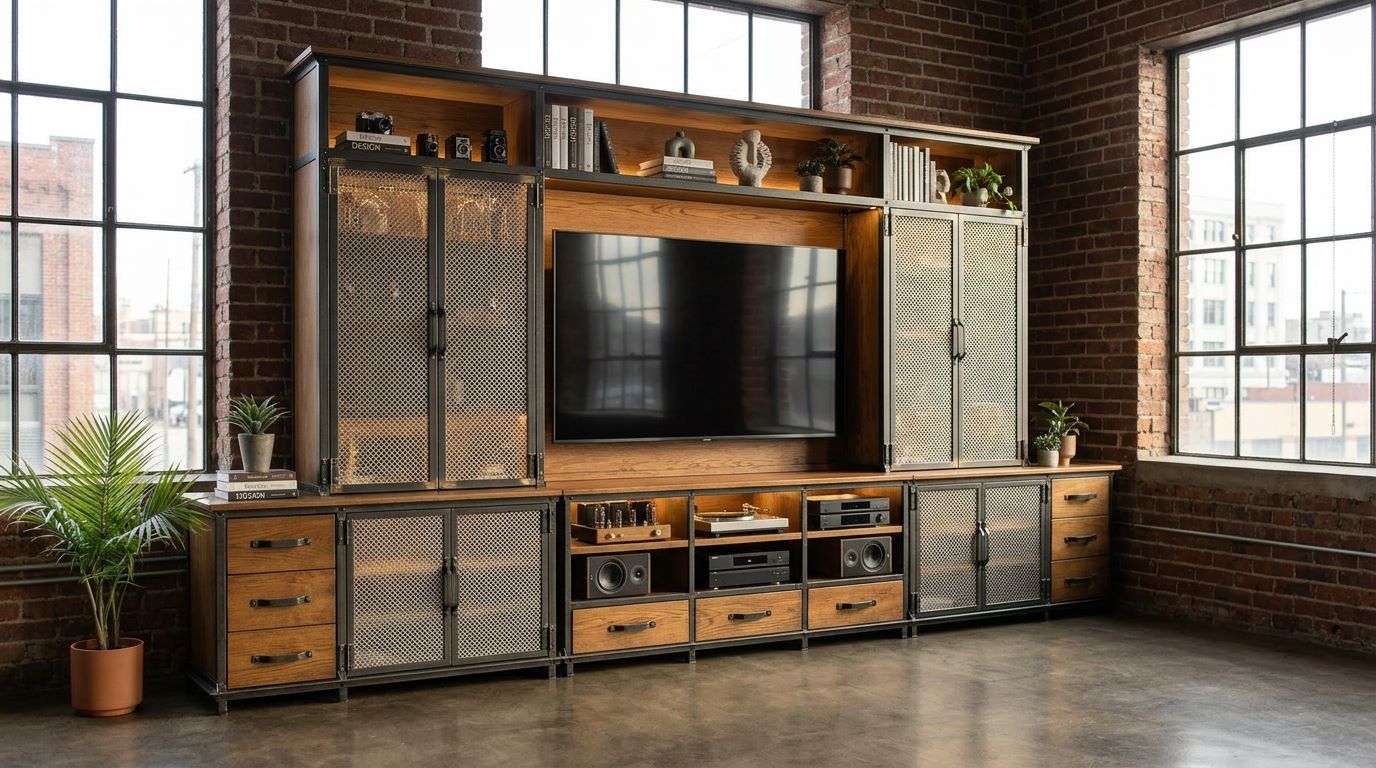
The people who have the most access to technology — the founders, the creatives, the architects, the executives — are deliberately surrounding themselves with the heaviest, most tactile, most undigital objects they can find. Thick steel. Rough timber. Welds you can see. Edges that don’t apologize.
This isn’t nostalgia. This isn’t a Pinterest mood board come to life. This is something deeper. Something almost biological.
And it has a name: Industrial Style Furniture. And at Vintage Industrial, we didn’t ride this wave. We helped generate it.
A Little History First — Because Context Is Everything
To understand why industrial furniture design has become the dominant aesthetic of serious interiors, you have to go back to a time when it was anything but dominant.
2009. The economy had just imploded. The concept of a “home office” still sounded vaguely like something your uncle did in his basement. Open-concept office design was just beginning to eat the corporate world alive. And if you wanted furniture with real industrial DNA — the kind forged from structural steel and solid hardwood, built like it belonged in a factory that outlasted two world wars — you had exactly two options.
Option one: spend your weekends crawling through salvage yards and antique shops, dragging home rusted machine bases and factory carts that may or may not survive another decade, that definitely didn’t fit your dimensions, and that you absolutely could not customize.
Option two: settle.
We chose option three. We opened a workshop.
What we recognized wasn’t just a gap in the furniture market. It was a gap in the conversation about what furniture could be. People didn’t want “old stuff.” They wanted the engineering philosophy of the early 20th century — the obsessive over-building, the unapologetic heaviness, the sense that this object was constructed to outlast whoever commissioned it — executed with the precision and customizability of the modern era.
We weren’t the first to love industrial aesthetics. We were the first to manufacture them at scale, to specification, with American materials and American craft. That distinction matters more now than it ever has.
Why Is Industrial Furniture Having a “Moment”? (It’s Not What You Think)
Ask most people why industrial style furniture is everywhere, and they’ll give you the safe answer: it looks cool. Clean lines, raw materials, a certain rugged elegance. Sure. That’s true. But that’s surface-level.
The real reason runs deeper, and it has everything to do with what the modern world has done to the human nervous system.
We live inside screens. Not just during work hours — all the time. The average professional in 2026 makes hundreds of micro-decisions a day in completely weightless, consequence-free digital environments. Click. Undo. Delete. Start over. Nothing sticks. Nothing has mass. Nothing pushes back.
Then they come home, or walk into their office, and they sit at a 2.5-inch slab of solid American Black Walnut resting on hand-rolled structural steel. They set their coffee down. They feel the surface. It doesn’t flex. It doesn’t apologize. It has been exactly where it is for fifteen years and it will be there for fifty more.
That is not a small thing. That is — quite literally — grounding.
Psychologists call it embodied cognition. The physical environment shapes how we think, how we feel, and how we perform. Heavy, stable, well-made objects signal permanence, authority, and craft. They communicate — without a word — that the person who chose them takes quality seriously.
That’s why the CEOs and creative directors and serious restaurateurs keep choosing industrial. Not because it’s trending. Because it works.
The Problem: Industrial Style vs. Industrial Build
Here’s where we have to have an honest conversation, because success breeds imitation and imitation breeds confusion.
Since the early 2010s, the phrase “industrial furniture” has been applied to approximately everything. Warehouse stores. Big-box retailers. Fast furniture brands. They all figured out the keywords. They all hired photographers who know how to make a hollow tube look like structural steel in the right light.
The result is a market flooded with what we call Industrial-Lite — furniture that looks industrial in a product photo and reveals its true nature the moment you actually touch it.
Here’s how to tell the difference:
The Mass Market Version: Hollow-core steel tubing. Faux-distressed powder coat. Veneers over MDF marketed with phrases like “reclaimed wood look.” Legs that wobble. Surfaces that scratch. Tables you can lift with one hand. Designed to photograph well, survive three years of moderate use, and get replaced when the next trend cycle hits.
The Real Thing: Structural-grade steel, hand-rolled and hand-welded by people who understand load-bearing fabrication — not assembly-line welders chasing production quotas. Solid timber: American Black Walnut, White Oak, reclaimed Mahogany — sustainably sourced, kiln-dried, finished to last generations. Every piece bespoke. Every dimension negotiable. Every weld visible, because we’re not ashamed of how it’s made.
The test is simple: if you can lift your conference table with one hand, it isn’t industrial furniture. It’s industrial cosplay.
What We Actually Build — And Why It’s Different
Our catalog isn’t organized around trend cycles. It’s organized around use cases and environments where quality actually matters.
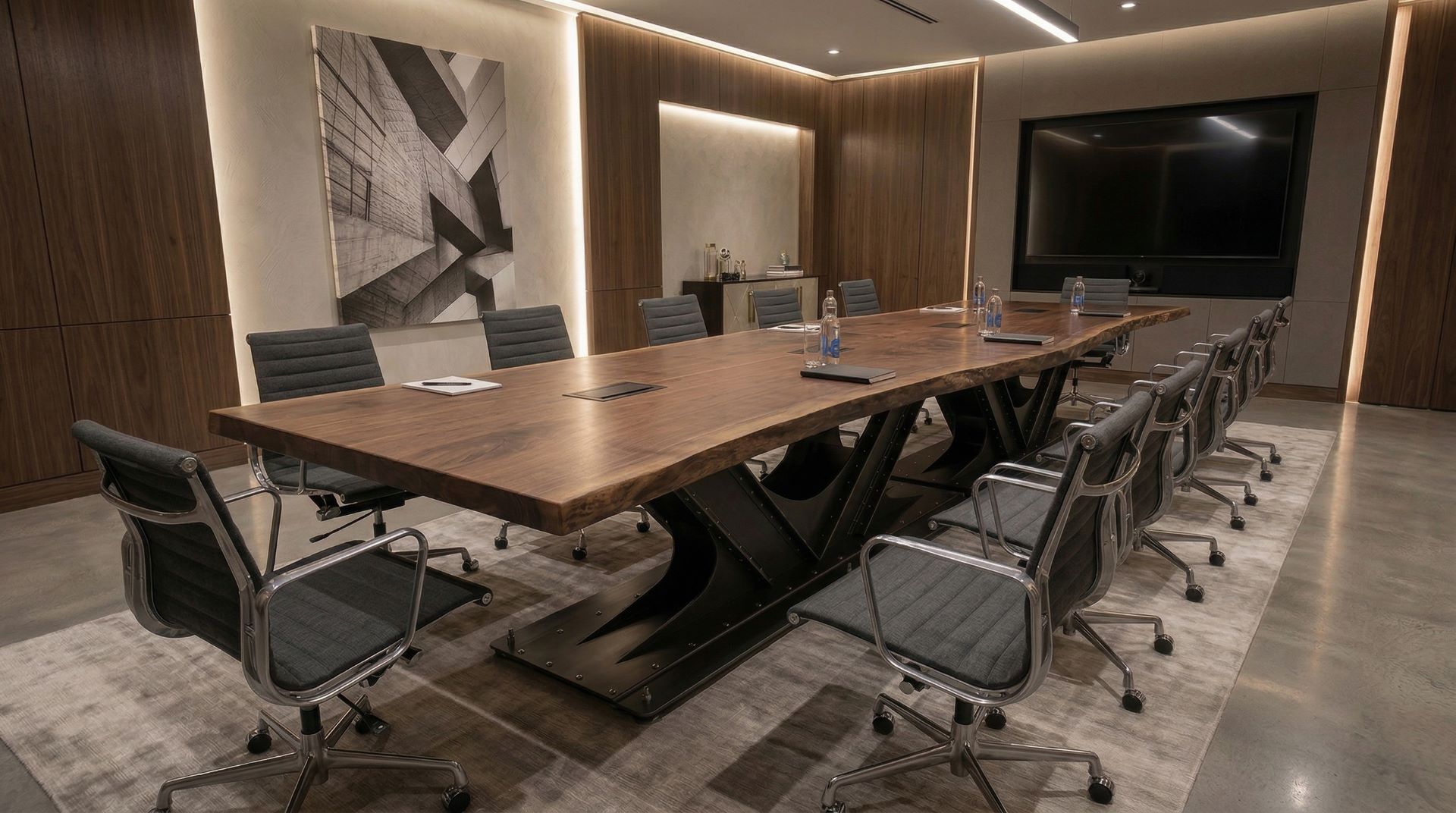
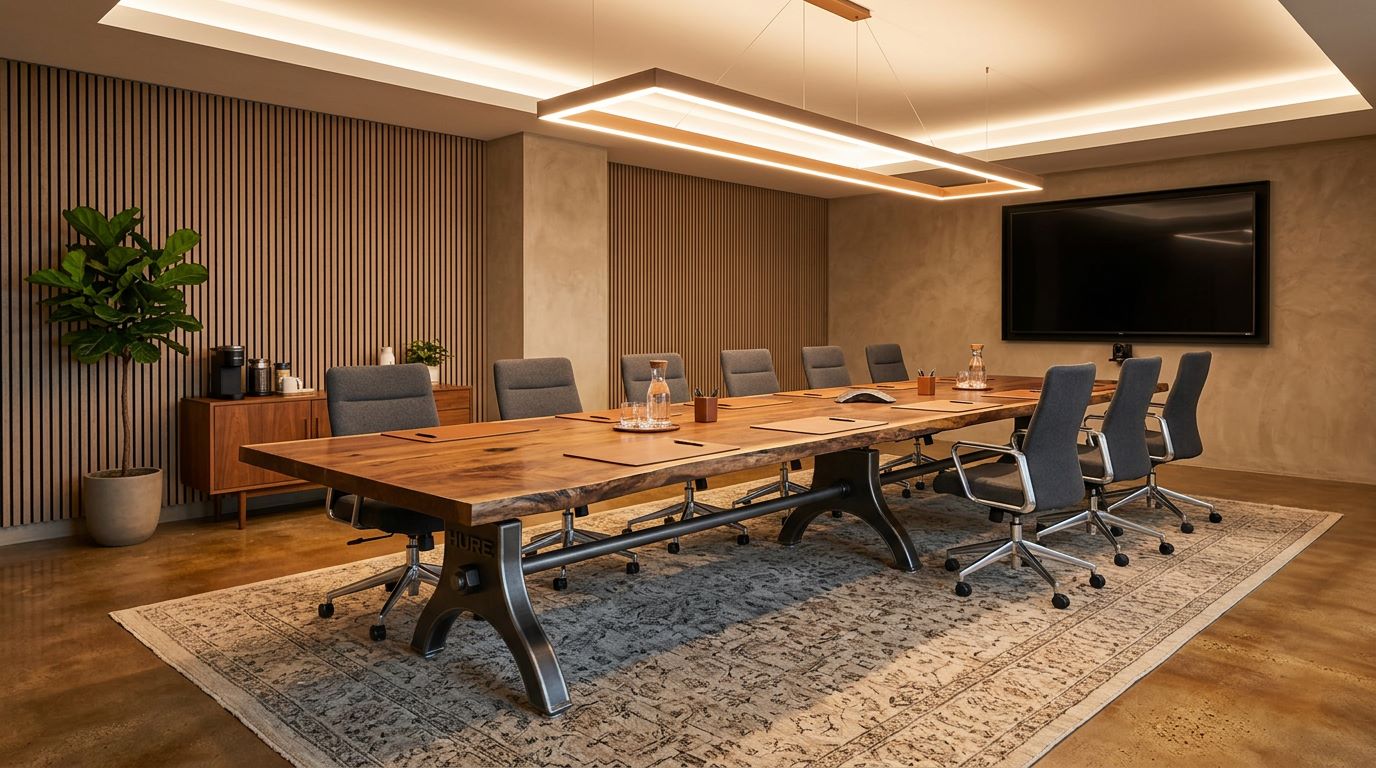
The IndustriaLux Series was designed for spaces that need to command a room without screaming. The kind of luxury industrial furniture that makes a client sit down and immediately understand who they’re dealing with. American Black Walnut slabs, live-edge and standard, on hand-rolled steel bases. The surface alone — a full 2.5 inches of solid hardwood — communicates something that no veneer ever could.
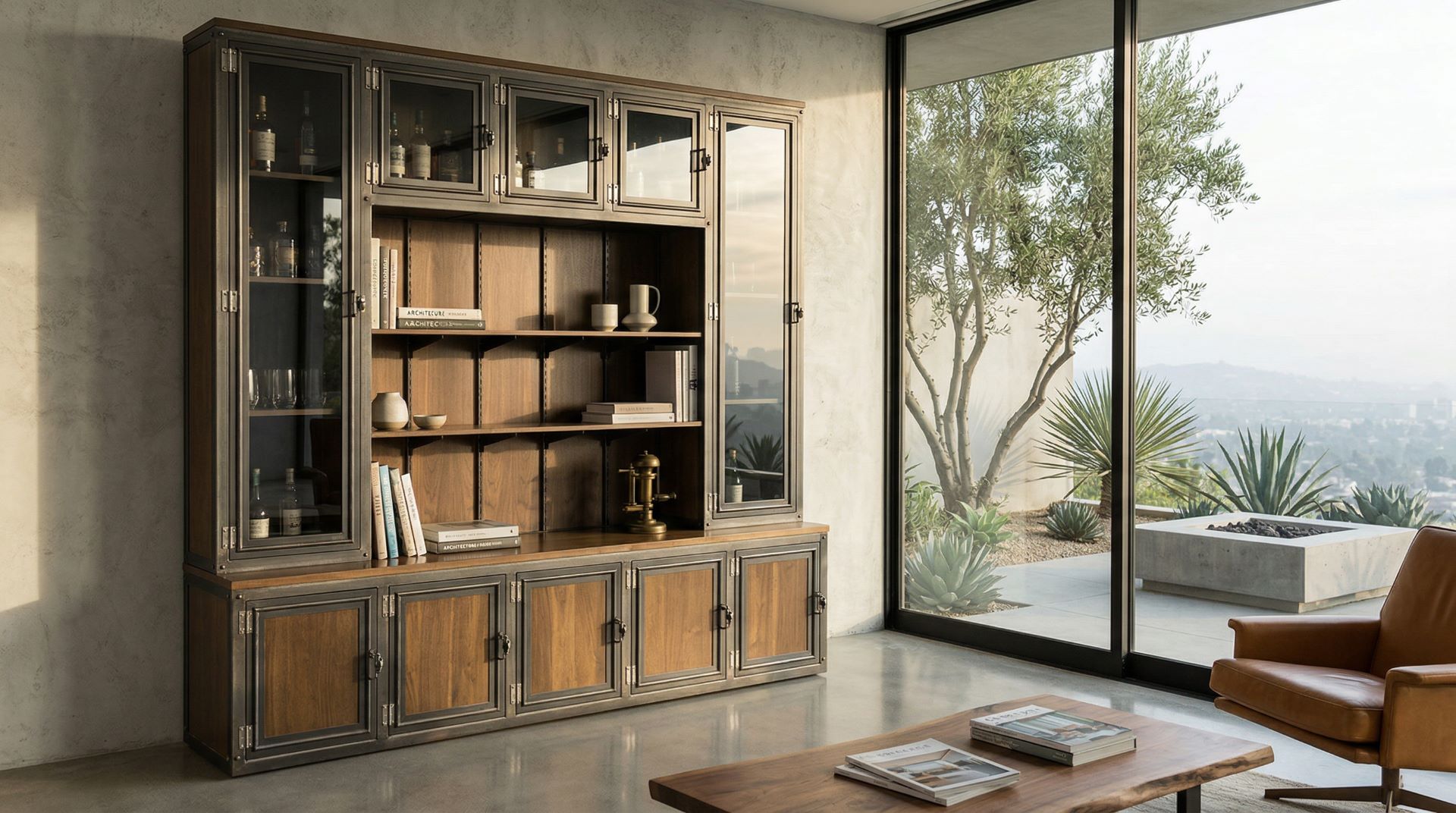
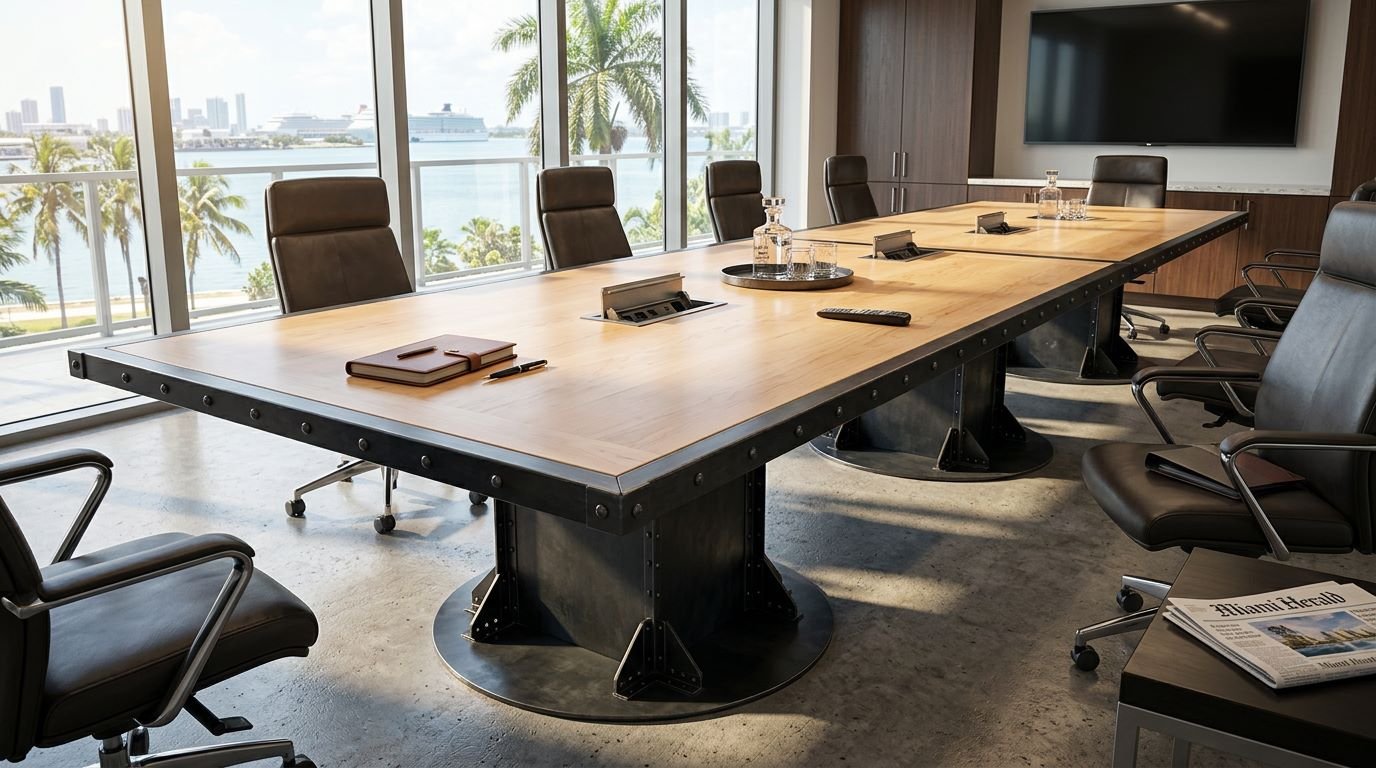
The VI-Beam Series takes the language of structural architecture and translates it directly into furniture. I-beam profiles. Exposed fasteners. Steel that was chosen because it’s right, not because it’s cheap. We hand select every sheet of steel, by the way, to make sure we like the grain and color. These aren’t pieces that try to look like they belong in a converted loft. They actually belong in one.
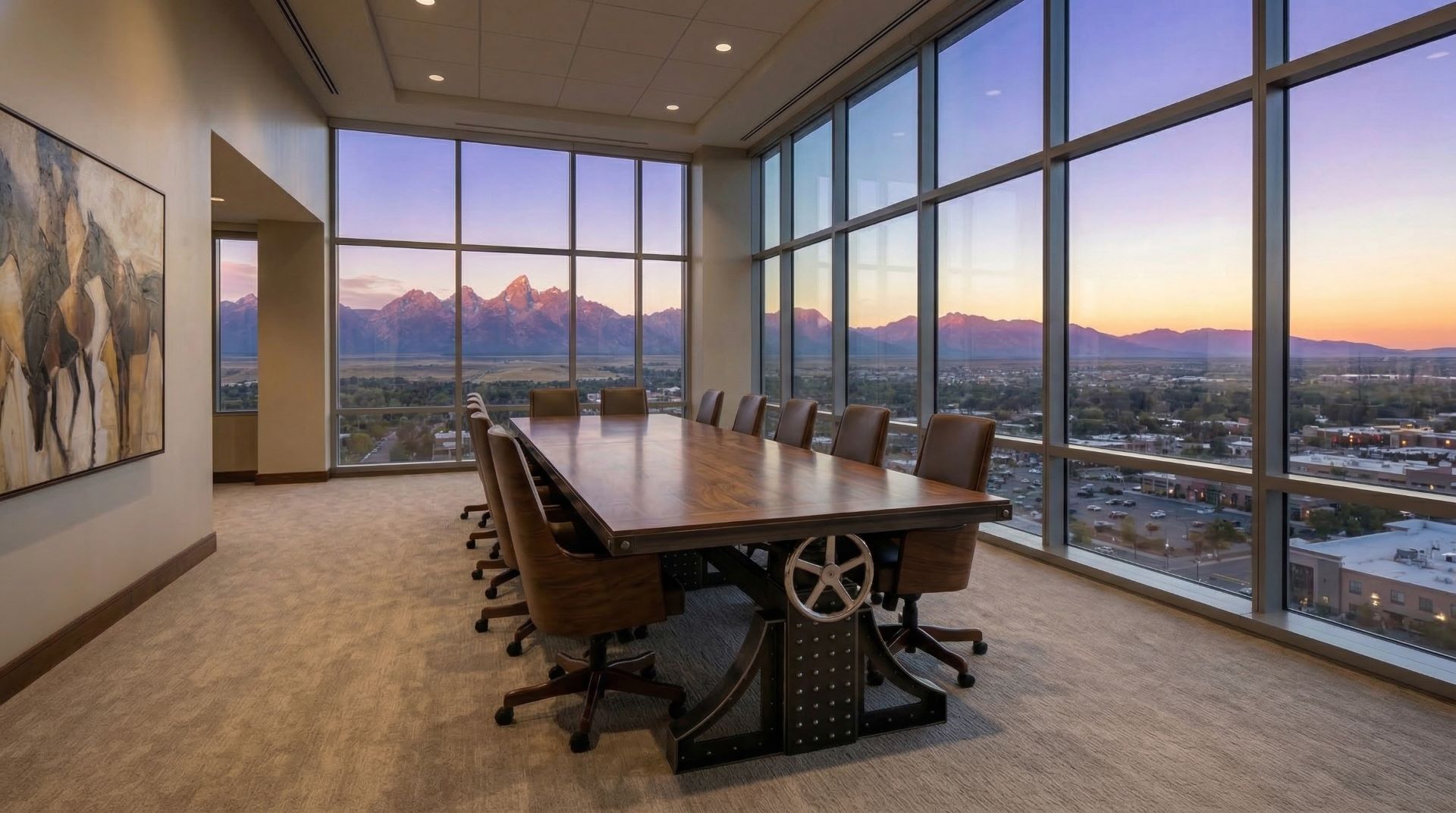
The Executive Boardroom Collection is where we build for permanence. These are conference tables designed for the rooms where decisions get made — not just background props for Zoom calls. When you’re hosting a negotiation or closing a deal, the table you’re sitting at sends a message before anyone says a word.
The Sustainability Angle (That Nobody Talks About Enough)
Here’s the uncomfortable truth about the fast furniture industry: it produces an extraordinary amount of waste.
When you buy a particle-board-and-hollow-tube “industrial” table for $400, you are — on average — buying something you’ll replace within five years. That object will end up in a landfill, along with its faux-wood coating and its off-gassing adhesives.
When you buy a piece of real industrial furniture — solid hardwood, structural steel, built to spec — you are buying something that will outlive you. Possibly your children. The carbon math on a piece of furniture that lasts 80 years versus four disposable pieces that each last 20 is not even close.
We source sustainably. We build permanently. Those two things are not a marketing pitch — they’re the only manufacturing philosophy that makes sense for objects this heavy.
Who Our Clients Are (And Why They Found Us)
We work with a specific kind of client. Not defined by budget — defined by intention.
They’ve usually already made the mistake. They bought the cheaper version, watched it wobble and scratch and age badly, and then started asking different questions. Not “how much does it cost?” but “how is it made?” Not “what’s available?” but “can you build it to my exact dimensions?”
Our clients are architects sourcing statement pieces for hospitality buildouts. They’re founders furnishing offices that need to feel like the company they’re trying to build. They’re homeowners who are done renovating every five years and want to fill a space with something that will still be the anchor of the room in 2050.
They find us because quality has a way of surfacing. A piece in a restaurant. A conference table they sat across from in someone’s office. A recommendation from a designer who’s been specifying our work for a decade.
They come back because the experience matches the object.
The Question We Get More Than Any Other
“Is industrial style going to go out of fashion?”
Here’s the honest answer: trends go out of fashion. Materials don’t.
Brick doesn’t go out of fashion. Timber doesn’t go out of fashion. Steel doesn’t go out of fashion. These are materials that humans have been drawn to for centuries because they are honest — what you see is exactly what they are. There’s no gap between the surface and the structure.
Industrial style, at its core, is just the application of that same philosophy to furniture. The aesthetic will evolve. The proportions will shift. But the underlying sensibility — heavy, honest, built to last — will never stop appealing to people who care about quality.
We’ve watched “industrial is dead” articles get published roughly every two years since 2012. The furniture in the photos accompanying those articles has been replaced three times. Ours hasn’t.
If You’re Serious About Your Space, Here’s Where to Start
Come to us with a problem, not a product number.
Tell us the room. Tell us how many people need to sit at the table. Tell us what the lighting is like, what the flooring is, whether you want live edge or clean lines, whether you’re running cables through the base or keeping it minimal.
We’ll build you something that solves it. Exactly to your dimensions. With materials you can verify and welds and fasteners you can see.
That’s not a sales pitch. That’s just what we do.
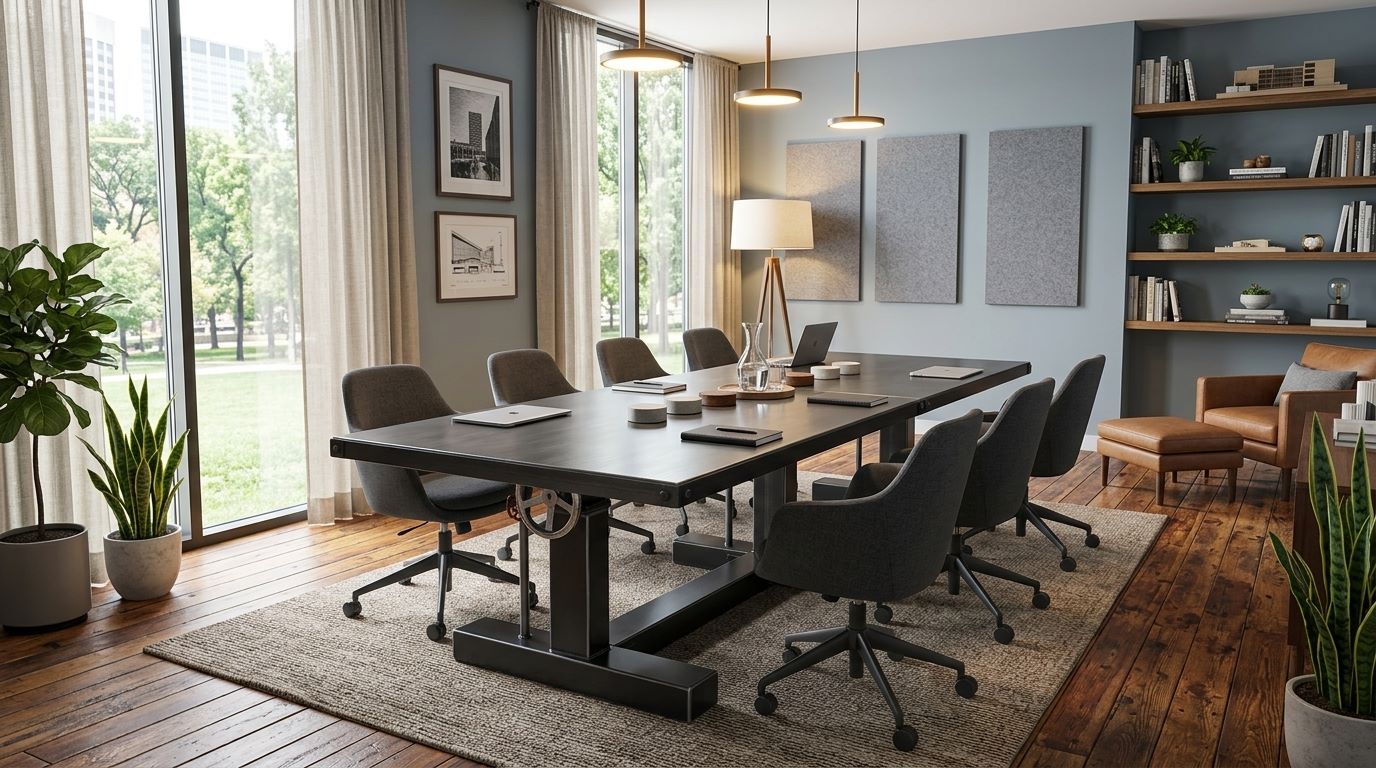
Explore the Executive Boardroom Collection → See our Original Crank Table Series → Start a custom build conversation
Vintage Industrial has been designing and manufacturing industrial style furniture since 2009. Every piece is built in the USA from structurally-graded steel and sustainably sourced solid hardwood — no veneers, no hollow cores, no compromises.