
Whether you’re furnishing a private office, a principal suite, or a home workspace that needs to hold up under real daily use — the goal is the same: a desk that fits the room, holds up for decades, and sends exactly the right message. Here’s how to get there.
What size executive desk do I need?
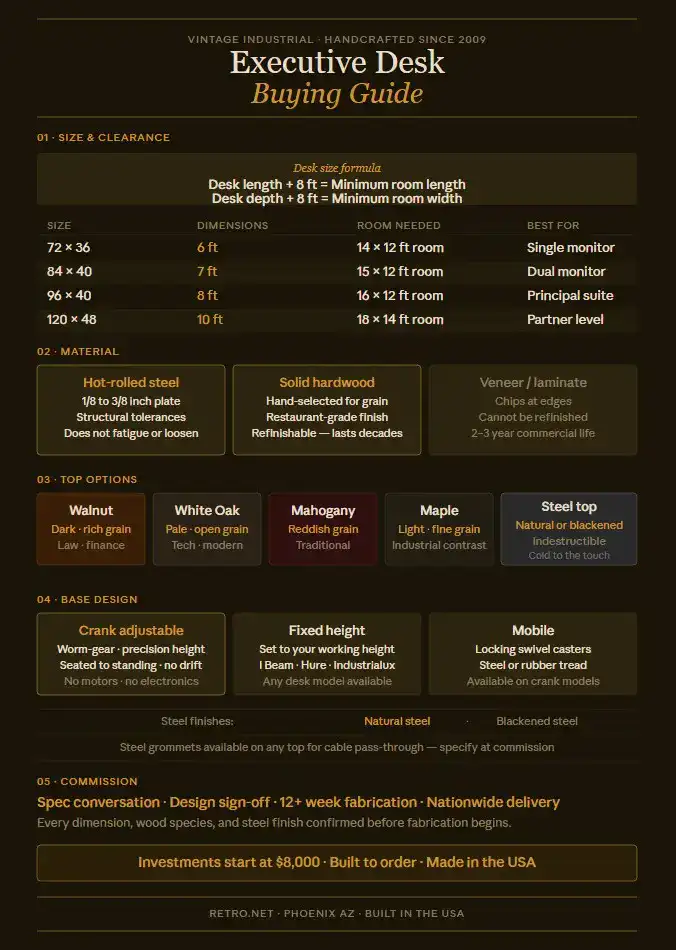
Size is where most desk purchases go wrong — usually too small, occasionally too large. The rule is straightforward: a primary single-monitor workstation works on a 72-inch desk. Add a second monitor, a large display, or a serious document workflow and you need 84 inches minimum. Executives who want presence in the room — the desk as a statement as much as a tool — typically land at 96 or 120 inches.
Depth matters as much as length. A 36-inch-deep surface gives you genuine working depth on a 72×36. At 40 inches — the standard on our 84-inch and longer desks — you have room for a monitor at proper distance, a document lane in front of it, and enough surface left over that the desk doesn’t feel crowded.
72 × 36
Single monitor
84 × 40
Dual monitor
96 × 40
Principal suite
120 × 48
Partner level
Desk length + 8 ft = Minimum room length
Desk depth + 8 ft = Minimum room width
For the full interactive room-fit tool — where you enter your room dimensions and see exactly what fits — see our executive desk size guide.
What your desk says before the meeting starts
Executive desks communicate. The material, the base design, the finish, the scale — all of it signals something about you and your organization before a word is spoken. Clients, candidates, and partners read a room instantly and without thinking about it. The question is what you want them to read.
Hot-rolled steel + solid hardwood — Precision, permanence, American craft. Built by people who build things. Common in law firms, architecture firms, and technology companies that want to signal they make real decisions here.
Veneer over particleboard — Functional and replaceable. Fine for a back-office workstation. Signals that the desk is furniture, not a statement.
Steel top — Unapologetically industrial. Less expensive than hardwood, effectively indestructible. Natural steel shows the warm grain of hot-rolled steel; blackened steel is darker and more uniform. Cold to the touch — worth noting for long desk sessions.
Veneer over particleboard — Functional and replaceable. Fine for a back-office workstation. Signals that the desk is furniture, not a statement.
The investment difference between a veneer desk and a solid hardwood and steel desk is real. The difference over ten years — accounting for replacement, disruption, and the ongoing impression the desk makes — typically runs the other direction. Investments start at $8,000.
“I’ve had Greg build three desks for our firm over fifteen years. Every one of them is still in daily use. We’ve replaced everything else in those offices twice over.”
— Law firm principal, 96-inch crank desk · Vintage Industrial customer
Height-adjustable vs. fixed: the crank desk case
A crank height-adjustable desk is not a standing desk trend piece. It is a precision instrument for ergonomic control — raise it for standing work, lower it for focused seated work, set it at the exact height your monitor, keyboard, and posture require. The mechanism is a solid steel worm-gear crank that adjusts in fine increments and holds position without drift.
For an executive who spends six to ten hours a day at a desk, the ability to change working position without interrupting work is one of the highest-return features available. Our crank desks are built on the same hot-rolled steel frames as our fixed-height desks — the mechanism adds function without changing the visual character.
Steel grommets and wire management
Every desk we build can be fitted with steel grommets — machined circular pass-throughs set flush into the solid hardwood top — for clean cable routing from monitor, power, and peripheral connections through the surface to management underneath. The grommets are finished steel, matching the frame, and sit flush when not in use. Note during your commission conversation if you want them, and specify how many and where on the surface.
Wood species: what each one actually means
Every wood species has a character. The right choice depends on the grain you want, how the top will be used, and what the room already has in it.


| Species | Character | Best for | Durability |
|---|---|---|---|
| WalnutDark, rich, tight grain | Warm and authoritative. The most requested species for executive and principal offices. Grain is tight and consistent — no surprises. | Law firms, financial services, executive suites | High. Resists denting well. Darkens beautifully over time. |
| White OakPale, open grain, neutral | Clean and architectural. Works with both dark steel and natural finishes. The grain has character without being loud. | Technology companies, architecture firms, modern interiors | Very high. Dense, stable, resists moisture well. |
| MahoganyWarm red tone, straight grain | Classic and refined. The traditional executive species. Warm reddish tone that reads as establishment without being stiff. | Traditional firms, private libraries, principal suites | High. Stable and easy to maintain. Ages gracefully. |
| MapleLight, fine grain, minimal figure | Bright and clean. The lightest option — pairs well with raw steel frames for a high-contrast industrial look. | Contemporary offices, high-contrast industrial interiors | Very high. One of the hardest domestic species. Resists wear. |
| Steel topNatural or blackened finish | Unapologetically industrial. The steel surface reads as structural — the same material as the frame, continuous from base to top. Natural steel shows the grain and character of hot-rolled steel; blackened steel is darker and more uniform. | High-contrast industrial interiors, offices where the industrial aesthetic is the point | Exceptional. Steel tops are effectively indestructible under normal office use. Note: steel is cold to the touch — a consideration for long hours of arm contact. |
Base design: what it does structurally and visually
The base carries the desk and defines its silhouette. For executive desks, the base also determines how the desk fits your work — whether you sit at a fixed height, adjust throughout the day, or need the flexibility to move the desk entirely.
Crank adjustable
A precision worm-gear mechanism allows continuous height adjustment from seated to standing. The crank handle is forged steel — no motors, no battery pack, no software to update. This is a desk that will outlast every piece of technology on it. Available on the Hure Crank Desk, the Original Crank Desk, and the Industrialux.
Fixed height
Built to a set working height confirmed during the commission conversation. Available on any desk model including the I Beam, Hure, and Industrialux. The right choice when ergonomics are already sorted and the desk is primarily a statement and a work surface.
Mobile
Locking swivel casters — steel or rubber tread — allow the desk to be repositioned without lifting. Each caster locks independently for a stable working surface when stationary. Available on crank models.
The commission process: what to expect
The reason most buyers default to catalog furniture is not price — it is uncertainty. Custom furniture feels like a black box: unclear process, unclear timeline, unclear outcome. Here is exactly how it works.
- You tell us what you needRoom dimensions, working height preference, monitor setup, aesthetic direction, any existing furniture or finishes to match. We ask the right questions — most clients don’t know what they need until we ask them.
- We spec the piece togetherLength, depth, wood species, base type, steel finish, grommets. Every dimension and material is confirmed before fabrication begins. Nothing goes to the shop without your sign-off.
- Fabrication begins12 or more weeks from commission to delivery. Steel is welded and finished by hand. Wood is selected, milled, and finished in multiple coats with a restaurant-grade sealer built for daily commercial use.
- Delivery and installationFreight delivery nationwide. White glove service — inside placement, unpacking, and full assembly — is available and confirmed during your commission conversation.
Greg’s take: what fifteen years of commissions actually teaches you
The most common mistake I see: people spec a desk to fit the room and forget to spec it to fit the work. Size up one step from where you think you need to be — you will use the space.
The second most common mistake: choosing a species from a photo. Wood looks different under different light, at different scales, and next to different materials. Tell me what the room has — flooring, wall color, existing furniture — and I’ll tell you which species reads best in that context.
The desks I’ve built that clients are most proud of are almost never the most expensive ones. They’re the ones where the size, the species, and the base landed exactly right for the room. When that happens, the desk disappears into the space the way good furniture should — present without demanding attention.
Ready to commission your desk?
Every desk begins with a conversation. Tell us about your space and we’ll work through the rest.