
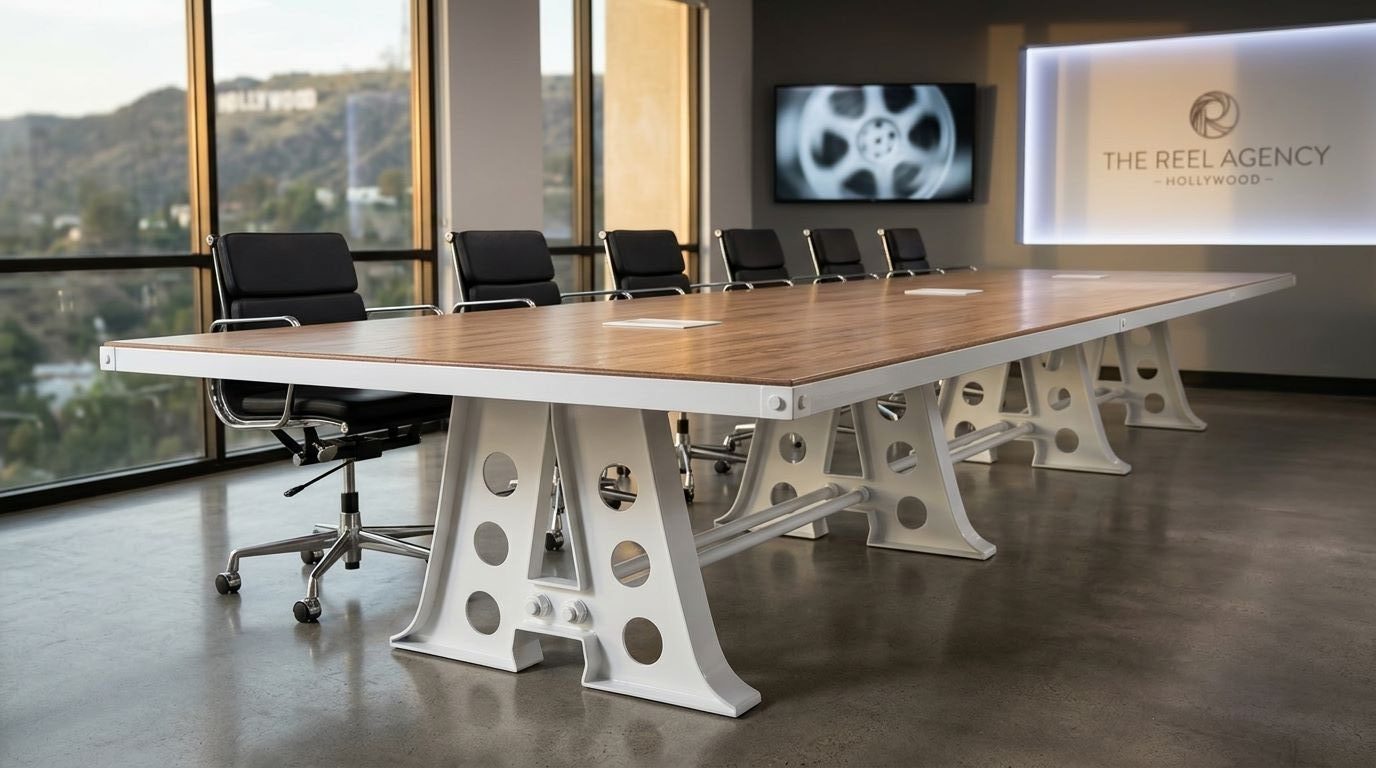
Choosing the right conference table size comes down to one number: the clearance ring around every seat. Get that right and the rest follows — length, width, seating capacity, room fit. This is the firsthand guide we built from years of designing and shipping custom conference tables to law firms, tech headquarters, and family offices around the world.
The Short Answer
Standard conference table sizes: 6 ft (seats 4–6) · 8 ft (seats 6–8) · 10 ft (seats 8–10) · 12 ft (seats 10–12) · 14 ft (seats 12–14) · 16 ft+ (seats 14–20).
Standard width: 40–48 inches. Below 40″ feels cramped for laptops and documents. Above 48″ makes face-to-face conversation harder.
Standard height: 30 inches. Sit-stand and crank-adjustable options range 28–42 inches.
Room clearance: Leave 36 inches minimum behind every chair. 48 inches if anyone walks behind seated guests.
If you’ve ever sat through a board meeting with your elbow in your neighbor’s coffee, you already know what the wrong-size conference table feels like. It’s not the table — it’s the math underneath the table. Conference tables follow a precise relationship between length, width, seat allocation, and room clearance. Miss one variable and the whole room collapses into awkwardness.
I’ve designed custom conference tables since 2009. The same questions come up every week: How long should it be? Will it fit our room? How many people can we seat? The good news is the answers aren’t subjective. They’re geometry. This is the guide I wish every client had before our first phone call.
How Conference Table Size Is Actually Calculated
The professional rule, used by commercial architects and corporate space planners, is straightforward: each seated guest needs 24 to 30 inches of horizontal table edge. That’s the minimum personal space for a laptop, a notebook, a coffee cup, and breathing room between elbows.
Twenty-four inches is the absolute floor — fine for short stand-ups where people aren’t spreading out materials. Twenty-eight to thirty inches is the standard for boardrooms, conference rooms, and any meeting where people will sit for an hour or more with documents, laptops, or shared materials.
Multiply by the number of seats along each long edge, add 24 inches per end seat (if you’re seating the ends), and that’s your minimum table length.
Here’s the working formula in practice. Take a meeting where eight people need to sit comfortably with laptops:
- 4 seats per long side × 28 inches per seat = 112 inches per side
- Add 12 inches of buffer at each end of the table (not seated) for visual proportion = 24 inches
- Minimum table length: 136 inches, or 11 ft 4 in
The nearest standard size is 12 feet (144 inches). That’s why eight-person executive boardrooms almost always end up at 12 feet, not 10. The 10-foot table looks right on paper, but the math says it can only honestly seat six along the long edges with the kind of breathing room executive use demands.
A 10-foot table doesn’t seat 10 people. It seats 8 comfortably. The number on the spec sheet and the number that actually fits at the table are almost never the same.
That single piece of math is responsible for more conference table sizing mistakes than anything else. Clients see “12 feet” and assume twelve seats. The reality is closer to ten — and that’s only if both ends are seated.
There’s a second variable that catalogs almost never mention: the visual buffer at each end. Industrial designers refer to this as “negative space” — the empty table surface that separates the last seat from the table edge. Without it, the end seats feel like they’re falling off the table. Twelve inches per end is the working minimum; eighteen inches is preferred for executive use. That buffer comes out of your usable seating length, which is why mathematical capacity and real-world capacity diverge.
Standard Conference Table Sizes and Seating Capacities
Here’s the working chart we use during commission conversations at Vintage Industrial. These figures assume 28 inches per seat (the standard for executive and boardroom use) and include end-seat capacity where applicable.
| Length | Width | Comfortable Seating | Maximum Seating | Best For |
|---|---|---|---|---|
| 6 ft (72″) | 36–40″ | 4–6 | 6 | Small offices, breakout rooms |
| 7 ft (84″) | 40″ | 6 | 6–8 | Mid-size meeting rooms |
| 8 ft (96″) | 40–48″ | 6–8 | 8–10 | Standard boardrooms |
| 10 ft (120″) | 48″ | 8–10 | 10–12 | Executive boardrooms |
| 12 ft (144″) | 48″ | 10–12 | 12–14 | Law firm partner rooms |
| 14 ft (168″) | 48–54″ | 12–14 | 14–16 | Corporate boardrooms |
| 16 ft (192″) | 54–60″ | 14–16 | 16–18 | Large boardrooms, government |
| 18–20 ft (216–240″) | 54–60″ | 16–20 | 20 | Headquarters, family offices |
For anything over 16 feet, we strongly recommend a sectional approach — two or three pieces that bolt together at the seam. A single 20-foot top is technically possible in solid hardwood, but the logistics of moving it through a building, around stairwells, and into the room are usually the deciding factor, not the woodworking. We’ve shipped 20-foot tables in three sections that aligned to less than a 64th of an inch at the seams. Always plan for delivery clearance first; design second.
Conference Table Width: Why 40 to 48 Inches Is the Working Range
Width gets less attention than length, and it shouldn’t. A table that’s the wrong width fails at exactly the moments it’s supposed to perform.
Under 40 inches: Two laptops face to face start to crowd each other, and documents passed across the table land in someone’s lap. Workable for short stand-up meetings; not recommended for executive use or anything that involves printed materials.
40 to 48 inches: The working range. At 40 inches, two laptops fit comfortably with a notepad between them — this is the most common conference table depth in our commissions and works well for almost every real-world meeting. From 42 to 48 inches you add breathing room for coffee, documents, and AV controls. Most executive boardrooms land somewhere in this range.
Above 48 inches: Conversation across the table starts to feel formal — voices get louder, eye contact gets harder to hold. Above 54 inches, you’ve crossed into “banquet hall” territory, which is fine for ceremonial boardrooms but works against collaboration. For tables over 16 feet long, we typically push width to 54 or 60 inches anyway, because narrow proportions on a long table read as visually unbalanced.
One detail that gets missed: width is also where you absorb a power and data grommet. If your table needs integrated power, plan for a 6-inch-wide grommet channel down the center. That cuts your usable surface by another inch on each side, so a 40-inch table with center power effectively gives each seat 17 inches of usable depth. Bump to 48 inches if you’re running integrated AV.
Room Clearance: The Invisible Constraint
The most expensive mistake in conference table sizing isn’t the table — it’s the room around the table. Clients call us with a measured room size and ask how big a table they can fit. The honest answer is almost always smaller than they hoped, because the table is only part of the equation.
The professional clearance standards we use at Vintage Industrial:
- Behind seated guests (no walk-through): 36 inches minimum, 42 inches preferred. This is the space for chairs to push back without hitting a wall.
- Behind seated guests (walk-through path): 48 inches minimum. This is the path for someone to walk behind seated colleagues without the seated person tucking in.
- Between table and AV credenza or sideboard: 48 inches. People need to get up, walk to the credenza, and return without anyone moving.
- Between table end and presentation wall: 60 inches minimum if anyone presents from the head of the room. Less than 60 inches and the presenter is standing on top of the end chairs.
The arithmetic is unforgiving. To fit a 12-foot table comfortably in a room, you need a room of at least 20 feet by 14 feet. That’s the table footprint (12 ft × 4 ft) plus 36 inches of pull-out on each long side and 48 inches at each end. If you have a 16 × 12 conference room, you’re not getting a 12-foot table in there — you’re getting a 10-foot.
Three room scenarios where clearance math kills the obvious choice:
- The pillar problem. Modern open-plan offices put structural columns in the strangest places. A column 36 inches inside the room wall reduces your effective room depth by that distance and forces the table to shift toward one side, which creates uneven clearance on the long edges. The fix is either notching the table to clear the column or stepping down a size.
- The door swing problem. If your conference room door swings inward, the door’s swing radius (typically 36 inches) becomes a clearance constraint. Cracking a door against the back of an executive chair is a guaranteed annoyance for the next forty years of the room’s life. Plan around it during table sizing, not after.
- The AV cart problem. Mobile AV carts, side credenzas, and rolling whiteboards all need parking space along one wall. Subtract their footprint from your usable room dimensions before calculating maximum table size.
A practical method we use during commission conversations: ask the client to measure the room, then subtract 96 inches from one dimension and 84 inches from the other. The remainder is the maximum table footprint that leaves proper clearance on all sides. This rule has been right within an inch every time we’ve used it.
Sit-Stand and Adjustable Conference Tables
Standard conference table height is 30 inches. That’s the figure every furniture supplier defaults to, and for good reason — it’s the height most chairs and elbow heights are engineered around.
But the last five years have produced a real shift in how executive rooms get used. Sit-stand executive desks are now the default in tech and finance. The next wave is sit-stand conference tables, where the entire surface raises and lowers for meetings that mix seated and standing work.
Two engineering approaches:
- Crank-adjustable (mechanical): A cast-iron crank mechanism, originally used on 1900s French factory tables, that raises and lowers the table with a hand crank. Range is typically 29 to 42 inches. Zero electricity, zero motor noise, no firmware. This is the approach we pioneered at Vintage Industrial with the Hure series in 2009.
- Electric sit-stand: Linear actuator legs with a control pad. Faster, quieter under load, but introduces a motor, a controller board, and a power requirement. Lifespan and serviceability are real considerations on a piece you intend to keep for forty years.
For pieces sized 6 feet to 10 feet, either approach works. For tables over 12 feet, the crank mechanism becomes mechanically advantageous — you’re lifting hundreds of pounds of solid hardwood, and a mechanical system without a motor doesn’t have a single point of electronic failure.
Seating Capacity: What “Seats 10” Actually Means
Furniture catalogs play loose with seating numbers. We don’t. Here’s the honest version.
Take a 10-foot table at 48 inches wide. Math says it can seat:
- 4 seats per long side × 28 inches = 112 inches (table is 120, fits comfortably)
- 1 seat per end = 2 end seats
- Total mathematical capacity: 10 seats
Now the reality check. End seats on conference tables are inherently awkward — they require the end chair to clear the table corner, which means either the chair is pushed back from the table edge or the seated guest is sitting at an angle. End seats also have no neighbor on one side, which changes the conversation dynamic. For executive use, we generally recommend leaving the ends open and seating only the long edges.
That same 10-foot table seats 8 people comfortably with both ends open, or 10 people maximum if you must seat the ends. The difference between “comfortable” and “maximum” is whether anyone needs to use a laptop, take notes, or have a beverage in front of them. For a stand-up meeting, you can pack people in. For a board meeting, comfortable is the only number that matters.
One more nuance: chair selection changes the math. A 24-inch-wide executive armchair eats more inches per seat than a 22-inch side chair. If your chairs are large (and most modern executive chairs are), bump the per-seat allocation from 28 inches to 30 or even 32. The Hure conference tables in many of our commissions are deliberately sized to accommodate Herman Miller Embody or Steelcase Leap chairs, which both run wide.
Shape Beyond the Rectangle
The rectangle dominates conference table design for one reason: it puts the most people closest to each other. But shape options exist, and each one shifts the room’s character.
Boat-shaped (subtle curve along the long sides): A signature executive boardroom shape. The slight bulge in the middle improves sightlines for video conferencing — every face is visible from every camera angle. Bumps your seating count by 1 to 2 compared to a pure rectangle of the same footprint.
Racetrack (rounded ends): Removes the awkward end-seat geometry by softening the corners. Visually less imposing than a rectangle and works well in rooms with curved architectural details.
Round: Caps out around 6 to 8 seats before conversation becomes impractical (people can’t hear across the table). Used for executive meeting rooms where equality of seat position is the design priority — no one sits at the “head.”
Oval: The compromise between rectangle and round. Seats 6 to 12 depending on length. Common in residential dining-meeting hybrid rooms.
For pure capacity and the most flexibility in how people use the room, rectangle wins. For executive presence and video-friendly geometry, boat-shape wins. Anything else is a stylistic choice with capacity tradeoffs.
Custom Sizes: When Standard Doesn’t Fit
Roughly 60 percent of the conference tables we ship are non-standard sizes. The reasons are usually one of three:
- The room is between standard sizes. A room that fits a 10-footer with awkward dead space at both ends often makes sense as an 11-foot table instead. We build to the inch.
- Seating count falls between standards. A team of 11 doesn’t fit comfortably at a 10-foot table and rattles around at a 12-foot. The right answer is an 11-foot table with deliberate seat spacing.
- The room has architectural constraints. Columns, alcoves, sloped ceilings, or low soffits all push tables into non-rectangular footprints. We’ve built tables with notched corners to clear structural columns and tapered ends to fit narrow alcoves.
Custom sizing doesn’t change our lead time materially — the steel base and the hardwood top are both built to spec regardless of whether the spec is a stock size or a one-off. What it does require is a precise room measurement at the start of the commission conversation, ideally a CAD drawing or a hand-sketched floor plan with column locations and door swings.
A representative example from a recent commission: a downtown law firm needed a boardroom table for fourteen partners in a 26-foot by 16-foot room with two structural columns on the north wall. Standard sizing math suggested a 16-foot rectangle. The column locations made that footprint sit asymmetrically, with one column inside the chair pull-out zone on the long side. The solution was a 15-foot boat-shaped table positioned 12 inches off-center, with a tapered end that cleared the column by 4 inches. The boat shape recovered the seating capacity lost to the shorter length, and the asymmetric placement made the room feel intentional rather than constrained. None of that is on a catalog spec sheet — and none of it would have been visible without the floor plan we asked for during the first conversation.
Materials: Why Steel and Solid Hardwood Outperform the Alternatives
Most conference tables on the market are MDF tops with veneer skin and powder-coated steel or aluminum bases. The reason is straightforward — it’s cheaper to produce, lighter to ship, and easier to mass-manufacture. The tradeoff is lifespan and presence.
A solid hardwood top on a hot-rolled steel base is a different category of object. It weighs more, costs more, and lasts longer than every veneer alternative on the market. We build for a forty-year service life as the design target, not the warranty term. The tops we ship today were milled from logs harvested in the last decade; the steel was rolled in domestic mills inside the last year. Both materials age into character. Veneer doesn’t.
For executive and luxury commercial environments, the conference table is also a signal. It tells the people sitting at it what kind of organization invited them. Solid materials, visible craftsmanship, and a base that looks engineered rather than decorated communicate something specific. That signal is part of the value.
One technical benefit that designers often overlook until the first video call: a massive solid hardwood table doesn’t just look powerful — the density of a 2-inch-thick hardwood top naturally dampens sound, reducing the echo-chamber effect common in modern glass-walled boardrooms. The same mass that gives the table its physical presence also gives the room its acoustic shield. AV directors notice this within the first meeting. It’s not a marketing claim; it’s a property of the material.
A Brief History of the Modern Conference Table
The shape of the room you’re planning has a longer history than most people realize. The modern executive boardroom is a direct descendant of two earlier traditions that fused in mid-twentieth-century corporate America.
The first tradition is the long refectory table — the monastic dining surface designed to seat a community along its length while preserving sightlines from one end to the other. Refectory tables were built by joiners, not cabinetmakers, with thick tops and trestle bases that prioritized structural permanence over decoration. The proportions we still use today for boardroom tables — long, narrow, low to the floor — are inherited almost unchanged from that medieval template.
The second tradition is the cast-iron base of late-nineteenth-century French industrial machinery. Through the late 1800s and into the early twentieth century, French manufacturers produced lathes, milling machines, and shop equipment on cast-iron bases that were as carefully designed as the machines they supported. P. Hure, a Parisian manufacturer who produced lathes and milling machines from the late 1800s into the 1940s, was one of the few who signed his work — a small touch that signaled the kind of pride craftsmen of that era put into ordinary objects. We named our Hure base after him because the elegance of his machinery bases was visible even on equipment that didn’t strictly need beauty to function. The crank-adjustable mechanism we engineer onto the Hure base today is our own design, inspired by the broader vocabulary of industrial-era machinery rather than any specific historical patent.
The conference table as we know it — the long form of the refectory table executed at the engineering tolerance of the industrial workshop — became the standard executive object roughly in the 1960s, when post-war American corporations needed visual language for their new boardrooms. The first generation of those tables was largely walnut over cast-iron pedestals, made by furniture houses now mostly gone. The second generation, in the 1970s and 1980s, shifted to MDF veneer over chrome and aluminum, which is the dominant form on the market today.
The work we do at Vintage Industrial is a deliberate return to the first generation. Hot-rolled steel bases, solid hardwood tops, mechanical adjustability where it serves the room — the engineering heritage is visible in every commission. The Hure conference table in our collection carries the name of a Parisian machinery maker who took the time to sign his work, and the engineering inside it carries the same conviction.
Frequently Asked Questions
Five Conference Tables from the Vintage Industrial Collection
Each piece is built to order in Phoenix from hot-rolled steel and solid hardwood. Length, width, height, and seating capacity are confirmed during the commission conversation.

The Hure
Crank-adjustable · Solid hardwood top · 8 to 20 ft

The VI Beam
Structural I-beam base · Solid hardwood · 8 to 20 ft

The Crank
Mechanical crank base · Sit-stand · 6 to 16 ft

The Bronx
Adjustable height · Steel pedestals · 8 to 14 ft

The Post Industrial
Rational base geometry · Solid hardwood · 8 to 18 ft
Still unsure what size your room needs? Our interactive conference table size guide includes a clearance visualizer, headcount-to-length recommender, and a room planner that confirms whether your space fits the table you’re considering before the commission begins.