
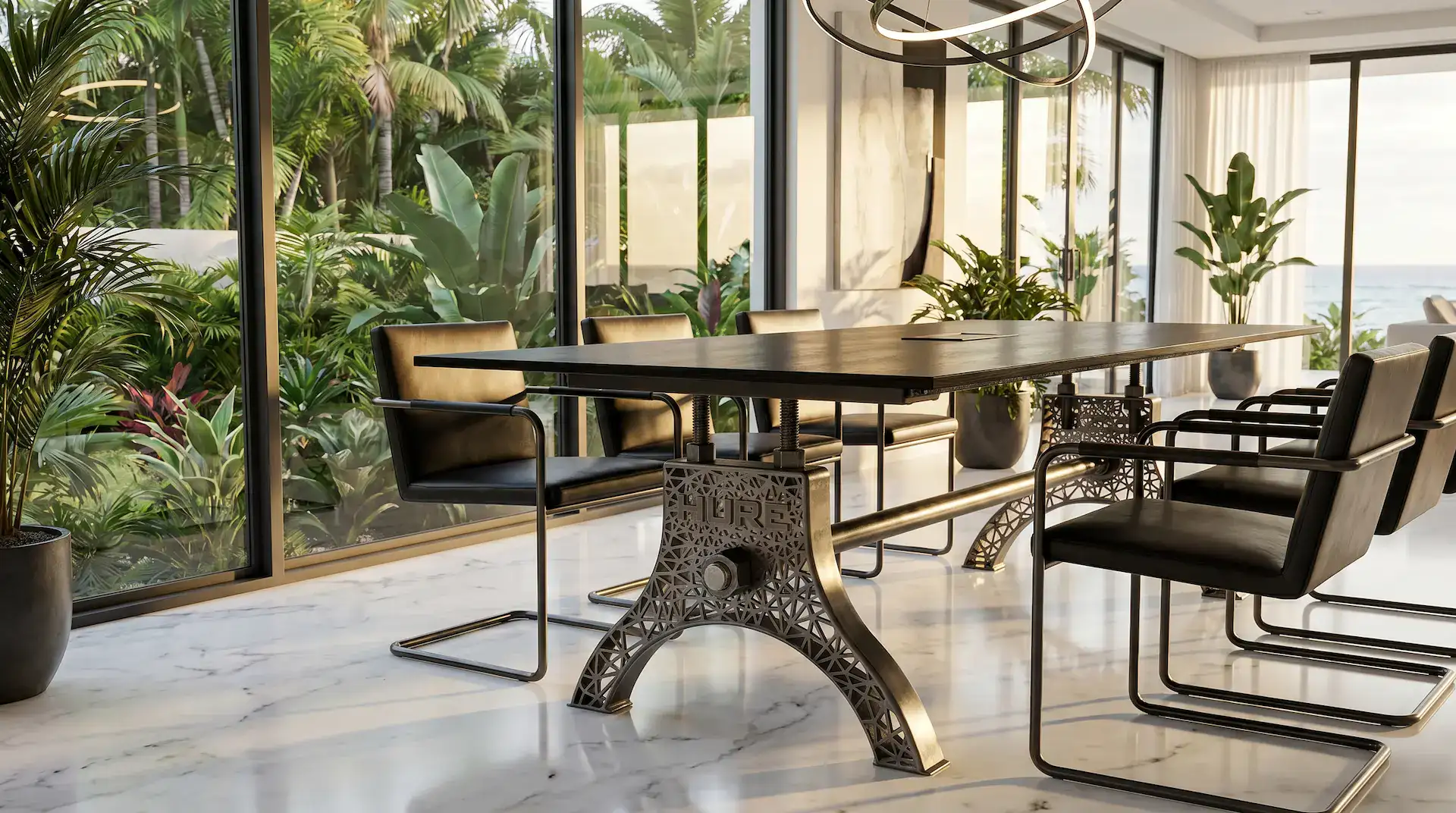
A dining table is the most-used piece of furniture in a home — and the one most often sized wrong. Get the math right and your dining room works for fifteen years; get it wrong and you’ll be reaching past your neighbor for the salt for the rest of your life. This is the firsthand guide we built from designing and shipping custom dining tables to homes, restaurants, and family compounds across the country.
The Short Answer
Standard dining table sizes: 4 ft (seats 4) · 6 ft (seats 6) · 7 ft (seats 6–8) · 8 ft (seats 8) · 10 ft (seats 10) · 12 ft (seats 12).
Standard width: 36 to 44 inches for rectangular tables. Below 36″ feels tight for plates and serving. Above 44″ makes passing dishes across the table awkward.
Standard height: 30 inches. Counter-height runs 36″; bar-height runs 42″.
Room clearance: Leave 36 inches minimum between the table edge and the nearest wall or furniture piece. 48 inches if anyone walks behind seated guests.

The IndustriaLux Heritage

The Small Hure Crank
The dining table is unusual among furniture. A sofa can be slightly too big for a room and you adapt. A bed that’s too small means a worse night’s sleep, not a worse life. But a dining table that’s the wrong size shows up at every single meal — every dinner party, every Sunday breakfast, every holiday — for as long as you own it. The cost of getting it wrong is fifteen years of small daily frustration.
The good news: dining table sizing is not subjective. Like conference tables, it’s geometry — a relationship between the number of seats, the per-person allowance, the table width, and the room clearance. Get the math right and the rest follows. This is the working guide I wish every client had before our first conversation.
How Dining Table Size Is Actually Calculated
The professional rule, used by interior architects and dining-room planners worldwide, is straightforward: each seated guest needs 22 to 26 inches of horizontal table edge. That’s the personal space for a place setting, a glass, a side plate, and elbow room between neighbors.
Twenty-two inches is the floor — fine for cafés and breakfast spots where people eat quickly without much hardware on the table. Twenty-four inches is the residential standard for everyday family use. Twenty-six inches is the executive standard, used in dining rooms where meals run long, plates are larger, and wine glasses, water glasses, and a side plate all sit at the same setting.
Multiply by the number of seats along each long edge, add 24 inches per end seat (heads of the table), and that’s your minimum table length.
Here’s the working formula in practice. A family of six who entertains regularly:
- 2 seats per long side × 24 inches = 48 inches per side
- Plus end seats (two heads of table) = 2 end seats
- Add 12 inches of visual buffer at each end = 24 inches
- Minimum table length: 72 inches, or 6 feet
The nearest standard is a 6-foot table. So a family of six who entertains regularly should be looking at a 6-foot dining table, not a 7-foot. The math says so before the showroom does.
The biggest dining-table sizing mistake isn’t buying too small. It’s buying for the holiday dinner that happens twice a year instead of the family dinners that happen 365 times.
Every client we work with has the same instinct: pick the largest table that fits the room, because what if the in-laws come? The honest answer is that an 8-foot table sized for a 4-person family seats those four people in a half-empty room every night, and only delivers value twice a year when extra guests arrive. Better to size for daily use and add a leaf or extension for occasional events.
Standard Dining Table Sizes and Seating Capacities
Here’s the working chart we use during commission conversations at Vintage Industrial. These figures assume 24 inches per seat (residential standard for everyday family use) and include end-seat capacity at the heads of the table.
| Length | Width | Comfortable Seating | With End Seats | Best For |
|---|---|---|---|---|
| 4 ft (48″) | 30–36″ | 2–4 | 4 | Breakfast nooks, small apartments |
| 5 ft (60″) | 36″ | 4 | 4–6 | Small family dining |
| 6 ft (72″) | 36–40″ | 4–6 | 6 | Standard family dining |
| 7 ft (84″) | 40″ | 6 | 6–8 | Family + occasional guests |
| 8 ft (96″) | 40–44″ | 6–8 | 8 | Family dining + regular entertaining |
| 9 ft (108″) | 42–44″ | 8 | 8–10 | Frequent entertainers |
| 10 ft (120″) | 44–48″ | 8–10 | 10 | Large families, dinner-party hosts |
| 12 ft (144″) | 44–48″ | 10–12 | 12 | Estate dining, restaurant private rooms |
| 14+ ft (168″+) | 48–54″ | 12–14 | 14+ | Compound dining, banquet hall |
For dining tables over 12 feet, we recommend a sectional or extension approach — either a leaf system that adds 18 to 24 inches to a base table, or a true two-piece construction with a precision seam down the center. Solid hardwood tops over 12 feet can be built as one piece, but moving them through interior doorways and around stairwells often dictates the decision. We’ve shipped 14-foot dining tables in two pieces that aligned at the seam to less than the width of a fingernail. Plan delivery clearance before you plan the table.
Dining Table Width: Why 36 to 44 Inches Is the Working Range
Width gets less attention than length, and it shouldn’t. A dining table that’s the wrong width fails at the moment it matters — when the food arrives.
Under 36 inches: Place settings start to crowd each other across the centerline. There’s no room for serving dishes down the middle of the table, which forces family-style serving onto a sideboard or kitchen counter. Workable for café tables and breakfast nooks; tight for any dinner that involves shared platters.
36 to 44 inches: The working range. At 36 inches, two place settings fit comfortably face-to-face with room for a single centerpiece runner. At 40 to 44 inches, you have a usable middle channel for serving platters, water carafes, candles, and a centerpiece that doesn’t disappear when food arrives. This is the range that lands in our commissions most often.
Above 44 inches: Passing dishes across the table starts to require standing or asking. Above 48 inches, conversation across the table gets harder — voices have to rise, eye contact strains. For restaurant-scale or estate dining tables over 12 feet, widths of 48 to 54 inches keep the proportions visually balanced; for residential dining under 12 feet, anything over 44 inches starts to feel oversized.
One detail almost no spec sheet mentions: width is also where chair-arm clearance lives. Modern dining chairs with arms run 24 to 26 inches wide. If your table is 36 inches deep and the chairs have arms, the arms will hit the table apron when pushed in — unless the table has a recessed apron or no apron at all. The solid hardwood tops we build have minimal aprons specifically so armchair clearance isn’t a problem at any width.
Room Clearance: How Much Space Does a Dining Table Really Need?
The most expensive sizing mistake isn’t the table — it’s the room around the table. Most dining rooms can fit a larger table than they should. The honest planning rule we use at Vintage Industrial:
- Behind seated guests (no walk-through): 36 inches minimum. This is the space for chairs to push back without hitting a wall, sideboard, or sliding door.
- Behind seated guests (walk-through path): 48 inches minimum. This is the path for someone to walk behind seated diners — to the kitchen, the sideboard, the bathroom — without making the seated person tuck in.
- Between table and sideboard or buffet: 42 inches. Enough room for someone to stand at the sideboard, serve, and return without anyone moving.
- From end of table to door swing: Account for the door’s full swing radius (typically 36 inches) plus seated chair pull-out (another 18 inches). A door 24 inches from a table corner will hit the corner chair every time someone walks in.
The arithmetic for a 6-foot dining table: you need a room of at least 13 feet by 9 feet for the table to seat 6 comfortably with proper pull-out clearance. For an 8-foot table, the room needs to be 15 feet by 9 feet. For a 10-foot table, 17 feet by 10 feet.
A practical planning shortcut: subtract 7 feet from one room dimension and 5 feet from the other. The remainder is your maximum table footprint with proper pull-out clearance on all sides. Anything larger and your chairs will be hitting the walls every time someone sits down.
Shape: Rectangle, Round, Oval, or Square?
Length and width assume rectangle — the dominant dining-table shape because it maximizes seating in a defined footprint. But the four shapes each have a personality, and the right one depends on the room and how the family actually eats.
Rectangle: The default. Seats the most people in a given footprint. Best for long rooms, narrow rooms, and any household that hosts more than a few times a year. Heads of the table create a natural conversation hierarchy — sometimes desirable, sometimes not.
Round: The conversational shape. No head of table; everyone is equal. Caps out at 6 people comfortably (anything larger and people can’t reach the center for shared serving). Best for square rooms and families that prioritize conversation over capacity. A 60-inch round seats 6; a 72-inch round seats 8 maximum.
Oval: The compromise between rectangle and round. Softer than a rectangle, more capacious than a round. Seats 6 to 10 depending on length. Excellent for rooms with curved architectural details or family settings where the seating count varies.
Square: The most space-efficient shape for 4 people in a small room. Beyond 4 people, square dining tables get awkward — the center becomes too far to reach across, and the geometry forces face-to-face seating that some families find too formal for daily meals.
For pure capacity and the most versatile entertaining, rectangle wins. For conversational dinner parties under 8 people, round or oval. For breakfast nooks and small apartments, square.
Height: Standard, Counter, or Bar?
Standard dining table height is 30 inches. That’s the figure every chair manufacturer engineers around, and it’s where the vast majority of commissions land. But two non-standard heights have legitimate use cases.
Counter height (36 inches): Pairs with counter stools. Common in open-plan kitchens where the dining table sits adjacent to a kitchen island of matching height. Visually consistent with the kitchen rather than the living room. Note: counter-height dining tables sit awkwardly in dedicated dining rooms; they only work in rooms that visually flow into kitchen counters.
Bar height (42 inches): Pairs with bar stools. Best for casual entertaining spaces, basement bars, and restaurant-style applications. Not recommended as a primary dining table — long meals at bar height fatigue the legs and back, and elderly or short-statured guests struggle to climb in and out of bar stools.
Standard height (30 inches): The right choice for a primary dining table in 95 percent of homes. Pairs with standard 18-inch-seat dining chairs. Comfortable for all heights and ages, all meal durations, and all dining traditions.
Custom Sizing: When Standard Doesn’t Fit
About 70 percent of the dining tables we ship at Vintage Industrial are non-standard sizes. The reasons are usually one of three:
- The room is between standard sizes. A dining room that fits a 7-footer with awkward dead space at both ends often makes more sense as a 7-foot-6-inch table. We build to the inch.
- The seating count falls between standards. A family of seven doesn’t fit comfortably at a 6-foot table and rattles around at an 8-foot. The right answer is a 7-foot 4-inch table with deliberate seat spacing.
- The room has architectural constraints. Bay windows, exposed beams, sloped ceilings, columns, and built-in cabinetry all push tables into non-rectangular footprints. We’ve built tables with notched corners to clear structural columns and tapered ends to fit narrow alcoves.
Custom sizing doesn’t change our lead time materially — the steel base and the solid hardwood top are both built to spec regardless of whether the spec is a stock size or a one-off. What it does require is a precise room measurement at the start of the commission conversation, ideally a CAD drawing or a hand-sketched floor plan with column locations and door swings.
A representative commission: a young family in a 1920s craftsman house in Pasadena needed a dining table for a room with an exposed brick chimney protruding 8 inches into the long wall. A standard 8-foot rectangle would have forced the table off-center; a 7-foot 4-inch rectangle with one corner softened to a 6-inch radius cleared the chimney by an inch and let the table sit perfectly centered on the room’s main axis. The table seats six daily, eight with leaves added. None of that geometry exists on a standard spec sheet — and none of it would have been visible without the floor plan we asked for during the first conversation.
Materials: Why Solid Hardwood and Steel Outlast the Alternatives
The dining table market is dominated by MDF tops with veneer skin, sometimes over metal bases, sometimes over particleboard pedestals. The reason is straightforward — it’s cheaper to manufacture, lighter to ship, and faster to mass-produce. The tradeoff shows up at year five, when the veneer at the corners starts to lift, water rings appear under finishes that weren’t designed for daily use, and the base wobbles enough to be noticeable.
A solid hardwood top on a hot-rolled steel base is a different category of object. It weighs more, costs more, and is built for forty years of daily use as the design target — not the warranty term. The tops we ship today were milled from logs harvested in the last decade. The steel was rolled in domestic mills inside the last year. Both materials age into character. Veneer doesn’t age — it fails.
One technical benefit that designers often overlook: a solid hardwood top with a properly applied conversion varnish or oil-wax finish handles spills, hot serving dishes, and the daily abuse of family meals without showing wear. Most veneer tops, regardless of marketing claims, are not rated for direct hot-dish contact. The most-asked question on our dining table commissions is “can I put a casserole dish on it without a trivet” — and on every table we ship, the honest answer is yes.
Frequently Asked Questions
Five Dining Tables from the Vintage Industrial Collection
Each piece is built to order in Phoenix from hot-rolled steel and solid hardwood. Length, width, height, and shape are confirmed during the commission conversation.

The Crank Table
Adjustable height · Hardwood plank top · 5 to 12 ft
The IndustriaLux Heritage
Architectural base · Solid hardwood · 6 to 14 ft

The Train Crank Table
Crank-adjustable base · Hardwood top · 6 to 12 ft
The Small Hure Crank
Compact crank base · Solid hardwood · 4 to 7 ft
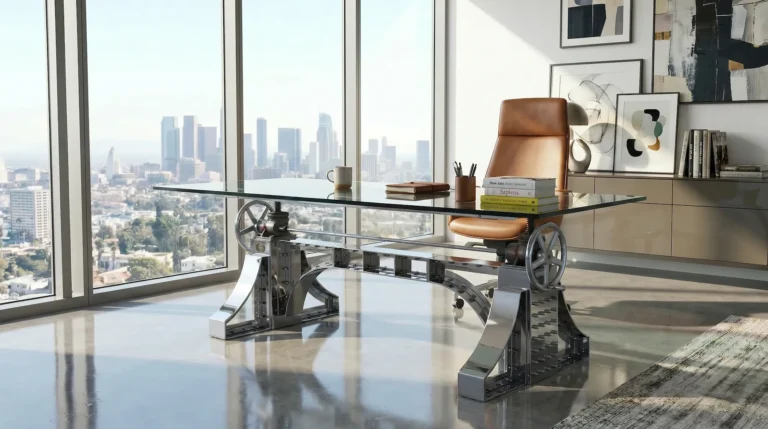
The Stainless Bronx Crank
Polished steel base · Mirror finish · 6 to 10 ft
Still unsure what size your dining room needs? Our interactive dining table size guide includes a room planner, headcount-to-length recommender, and scale comparison that lets you confirm whether your space fits the table you’re considering before the commission begins. You can also explore our full industrial dining table collection for design inspiration across sizes, shapes, and finishes, or browse our industrial crank tables for adjustable-height options that work as dining tables, workspaces, or both.
Designing a different kind of room? See our companion guides: the conference table size guide for boardroom planning, or the executive desk size guide for workspace sizing.